

What to Do in Finisterre at the End of the World in Spain
Finisterre is a village on the shores of the Death Coast of Galicia. It is best known as the End of the World for pilgrims walking from Santiago de Compostela. The way twists through the beautiful Galician countryside only to reach the rugged cliffs of Cabo Fisterra above the Atlantic Ocean.
For many, this is the End of the Earth; for many pilgrims, it’s the end of the journey.
While Fisterra may be the final stop for pilgrims, the village is a must-visit location on Galicia’s Death Coast.
Although small, there are many things to do in Finisterra. There are no large attractions, but highlights include the stunning Cabo Fisterra, a charming old town, a unique seafood market, lovely beaches, a museum, and more.
This short guide includes how to get to the End of the World, what to do in Finisterre, popular places to eat and sleep in town, and nearby places to see along the unmissable Costa da Morte.
Here’s a short guide to Fisterra in Galicia Spain and the best things to do there.
Table of Contents
- The Significance of Fisterra
- How to Get to Finisterre Spain
- 10 of the Best Things to Do in Finisterre
- Where to Eat in Fisterra
- Where to Stay in Fisterra Spain
- Places to See Near Fisterra on the Stunning Costa da Morte
- Is Finisterre Worth Visiting?
- Conclusion⎟What to Do in Finisterre Spain & The End of the World
The Significance of Fisterra Galicia

Fisterra (Finisterre) is often the end of the road for many pilgrims walking the Camino de Santiago. The name comes from the Romans, who believed this was the farthest point of the Iberian Peninsula. Finis (end) Terrea (Earth) literally translates to the End of the World.
Even before the Romans, it is believed that Fisterra was a sacred place for those Celtic tribes who lived in this region. They were pagans and worshiped nature, especially the sun. There are still places in Finisterre where it’s possible to see these ancient connections to the land.
Today, Finisterre is one of the most popular places to visit in Galicia.
How to Get to Finisterre Spain
Finisterre is found on the Death Coast in Galicia, Spain.
There are multiple ways to get to Finisterre. One of the most scenic ways is to walk from Santiago de Compostela. As it’s a popular day trip from Santiago de Compostela, it’s easy to join an organized tour that typically departs daily.
Independent travelers can hop on a bus or rent a car to explore the best of the Costa da Morte
Walk the Camino de Santiago Pilgrimage Route to Fisterra

The most popular way to get to the End of the World is to walk the Camino Finisterre Muxía. Pilgrims leave Santiago de Compostela to walk through small villages and the beautiful countryside to reach the sea.
The Camino Finisterre Muxia is the only pilgrimage route that starts at the Cathedral de Santiago de Compostela. The two main ending points of the Camino Finisterre are Finisterre or Muxía. However, it’s easy to walk between both.
The Camino from Santiago to Finisterre or Muxia takes an average of 3 days. The walking route that connects Finisterre to Muxia is less along the coast and more inland through a forestand is just around 29 kilometers (18 miles).
‼️ Pilgrims walking from Santiago de Compostela to Finisterre and Muxía, can pick up completion certifications from both village’s Tourist Information Centers.
🥾 Walking to the End of the World? Check out my Camino packing list & tips
Guided Tours from Santiago de Compostela to Finisterre

If limited time, the best way to visit Fisterra is to join a guided tour from Santiago de Compostela. Many of these tours stop at multiple locations on the Death Coast.
Highly-Rated Tours of Finisterre & Costa da Morte
➜ This popular Costa da Morte tour includes the main highlights of the Death Coast with stops in Fisterra, the Finisterre lighthouse, the Ezaro Waterfall, and a stop in Muxía before returning to Santiago de Compostela.
➜ This guided tour of the Costa da Morte stops at seven locations that highlight the Death Coast on a full-day trip.
➜ This is a full-day trip tour from Santiago de Compostela that stops at Finisterra and other points along the Death Coast
Buses to Fisterra from Santiago de Compostela
There are daily buses that connect Finisterre to Santiago de Compostela.
If visiting Finisterre from Santiago de Compostela, buses depart from the main bus station, Santiago de Compostela – Estación Intermodal, via the company Monbus.
The buses to Fisterra take around 2.5 hours. Some routes are shorter, and others longer, depending on which route the bus takes. Tickets cost around €7.35 for a one-way ticket. Oftentimes, online ticket sales offer a discount. Schedules fluctuate and change with the season.
Santiago de Compostela to Finisterre Buses via Monbus
| Santiago – Fisterra Departure Time | Bus Schedule |
| 9:00 | Daily |
| 9:15 | Daily |
| 10:00 | Daily |
| 12:00 | Saturday & Sunday |
| 13:00 | Weekdays |
| 15:20 | Saturdays ONLY |
| 18:15 | Saturday & Sunday |
| 18:30 | Weekdays |
➜ Make sure to check the up-to-date schedule and return tickets to Santiago de Compostela. This is a useful website to help navigate the bus system in Galicia.
Rent a Car to Explore the Death Coast
There are so many things to see and do along Spain’s overlooked Death Coast. Depending on what you wish to see, it may be best to rent a car to enjoy the Costa da Morte leisurely.
What to Do in Finisterre
Although small, there are plenty of things to do in Finisterre to keep visitors busy for a day or two. Those pilgrims walking can see quite a few of the main highlights on a lazy afternoon.
However, it would be easy to sleep an extra night in Fisterra to lounge at the many beaches or take a day trip to nearby places.
1 | Walk to the End of Cabo Fisterra

Finisterre is often the end of the road for many pilgrims, with one final pilgrimage to Cape Fisterra lighthouse. The Cape of Fisterra is around 2.2 miles from the village. Even if you didn’t walk the Camino, it’s possible to follow the arrows and pathways to the End of the World.
Alternatively, those with a car can find parking before the Finisterre lighthouse.
The Cabo Fisterra is one of the most popular things to do in Finisterre. It can be especially busy at sunset when the crowd cheers as the sun disappears into the sea.
2 | Spend Time Near the Finisterre Lighthouse
The cliffside Finisterre lighthouse (Faro de Fisterra) is the highlight of Cabo Fisterra. The lighthouse of Fisterra was completed in 1853. Besides the lighthouse, there are plenty of things to see on the cape.
Pilgrims are welcomed to the Cape with the final 0.0 KM marker of the Camino de Santiago. Before the lighthouse, find the Hotel O Semaforo, which was the lighthouse keeper’s residence. The hotel also offers a coffee shop and restaurant. On a nice day, catch a drink on the outdoor terrace.


Past the lighthouse, people gather to watch the waves hit the rocky cliffs at the End of the World. Along the stones, look for a stone cross and the famous boot sculpture.
Many people picnic on the stones surrounding the Finisterre Lighthouse to watch the sunset.
3 | See the Unique Christ Figure at Santa María das Areas
If walking from Fisterra to the Cape, pop in the church of Santa María das Areas. The church was built during the 12th century. Inside, find the famous figure of Jesus that comes with a legend. This lifelike figure was said to be found floating in the sea during the 14th century and now has a cult following due to its golden beard.
There are three of these figures, one at the Cathedral in Ourense and the other supposedly hidden privately in Burgos. Although it used to be on display at the Cathedral.
Pilgrims and visitors can enjoy an 18:00 daily mass at the Church of Santa Maria das Areas.
4 | Stroll Along Langosteira Beach

Langosteira Beach is a large and popular beach just before Fisterra. This spectacular beach is filled with seashells and has a wooden boardwalk. If you’re lucky, it’s also an amazing spot to catch dolphins splashing around.
5 | Relax at the Many Beach of Fisterra
While Langosteira Beach is one of the most popular, there are many other options. One of the best beaches is a rocky beach that can be accessed during low tide, hidden down Rúa Patres. Another beach with fewer tourists can be found on the west side of Fisterra, Mar de Fora Beach. This is a wild and rugged beach that is often quiet with few travelers.
6 | Take the Climb up to the Ruins of San Guillerme
Those interested in the history of Fisterra before Christianity shouldn’t miss a climb up Monte Facho. This area was believed to have a settlement in place around 1,000 B.C. Some legends believe the area is home to the ruins of an ancient chapel and maybe even the site of the Altar of the Sun (Ara Solis).
Besides the stunning views of the Cape, make sure to see the ruins of the Hermitage of San Guillerme.
Before Christianity, it was believed that couples struggling with fertility issues would walk the Camino and stop along the way to visit healers and medicine women. They would follow the Milky Way until modern-day Fisterra.
Pre-Christian symbols and petroglyphs can be found in many places along the Death Coast, including the energetic site of Monte Pindo.
At the end of the journey, the couples would head to these large stones near here. The stones were said to be mystical and offer healing powers. This space and sacred stones were used as a place where couples would try to conceive up until the 18th century.
7 | Explore the Historic Old Town

Monte Facho is said to have been inhabited for 1,000 years B.C. The Romans moved into Galicia a few hundred years before Christ, but the Celtic tribes resisted their presence until around 26 to 19 B.C. The area of Finisterre has been occupied by humans for thousands of years.
Today, the Old Town of Fisterra is more medieval, with the port at its heart. When an influx of pilgrims started walking to Fisterra, a pilgrim hospital was founded in 1497.
Today, the old town has small cobblestone streets lined with bars, restaurants, and shops, and is a delight to wander through.
Throughout all of its history, Fisterra has always been an important fishing village.
8 | Stop in at the Museum in Castelo de San Carlos

The Castelo de San Carlos is an old defensive fortress that was built during the 18th century. Today, it has been converted into a fishing museum. Visits cost 2 Euros and include a guided tour that takes around an hour.
Castelo de San Carlos Museum⎜Find it here: Rúa Alfredo Saralegui, 5 ⎜Hours: Tuesday – Saturday, 11:00 – 14:00 / 16:00 – 19:00, Sundays open in the morning only, Closed Mondays
9 | Enjoy A Meal in the Plaza of Paseo Ribeira


In Finisterra, don’t miss a chance to eat fresh Galician seafood along Paseo Ribeira. During the summer months, tables spill out into the plaza. There isn’t a bad seat in the house with spectacular ocean views.
10 | Observe the Fish Auction at the Local Market
Fisterra has deep roots connected to the sea. Many of the townspeople survive by fishing and working at sea. The Fish Market (Lonxa de Fisterra) was opened in 2008 and is the centerpiece of the port.
Locals still show up at the local fish market to attend an auction of local seafood coming in fresh. The auctions are held Monday – Friday around 16:30.
Where to Eat & Drink in Finisterre


There are tons of places to eat in Fisterra. Since this is ultimately a famous fishing village, one thing you must try is the fresh fish and seafood.
There are a handful of restaurants along the waterfront that serve up excellent seafood near the Fish Market. The plaza on Paseo Ribeira across from the market is a great place to start.
✔ Follow Paseo Ribeira to Restaurante Terra, Fisterra’s only recognized Michelin Star Restaurant (one star).
✔ O Pirata is a great place to eat the typical fresh seafood found in Galicia
✔ The World Family is known for its vegetarian and vegan cuisine at a good price
✔ Etel & pan is a fabulous place to eat a burger or a fresh bocadillo (sandwich)
✔ Panaderia Germán is an excellent bakery and coffee shop with a super cute ambiance
✔ A Galería Bibliotaberna is the place to stop for a drink in Fisterra! The decor is so fun, and the views are even better
Where to Stay in Fisterra Spain

There are many different types of accommodations in Finisterre for all types of budgets. Find budget-friendly albergues, pensions, and hotels.
Municipal Albergue in Fisterra
The cheapest place to stay in Fisterra is the Municipal Albergue. This 26-bed pilgrim hostel is only available to pilgrims walking the Camino Finisterre – Muxía. To sleep here, you must be carrying the Pilgrim Credential, or passport, which requires a daily stamp.
Municipal Albergues do not allow reservations and are on a “first-come, first-served” basis. Like all Municipal Albergues sponsored by Galicia’s local government, the Xunta, a bed costs 10 Euros. In the Municipal Albergues, it is only possible to sleep one night here.
Private Albergues in Finisterre
Anyone, whether or not they are walking the Camino Finisterre Muxia, can sleep in private albergues. The private Albergues in Muxia run around €15 – €20 a night, and it’s possible to sleep in these hostels for more than one night.
Many of the albergues also offer private rooms, as well as large shared rooms.
- Albergue-Pensión Cabo da Vila
- Albergue de Sonia
- Albergue La Espiral
- Albergue Por Fin
- Albergue Mar del Plata
More Popular Places to Stay in Finisterre
There is also a wide range of hotels in Fisterra, pensions (cheaper accommodations), and private apartments.
- Hotel Faro de Finisterre
- Hotel SempreFisterra
- Pensión Mirador Fin da Terra
- Hotel Costa da Morte
- Hotel VIDA Finisterre Centro
- Hospedaxe Memorias de Sophia
➜ Browse all the Best Places to Sleep in Fisterra Galicia
Incredible Things to See Near Finisterre (Day Trip Ideas)
If you have a car, it would be easy to visit these highlights over a few days. It’s possible to combine a few of these sights over a full day.
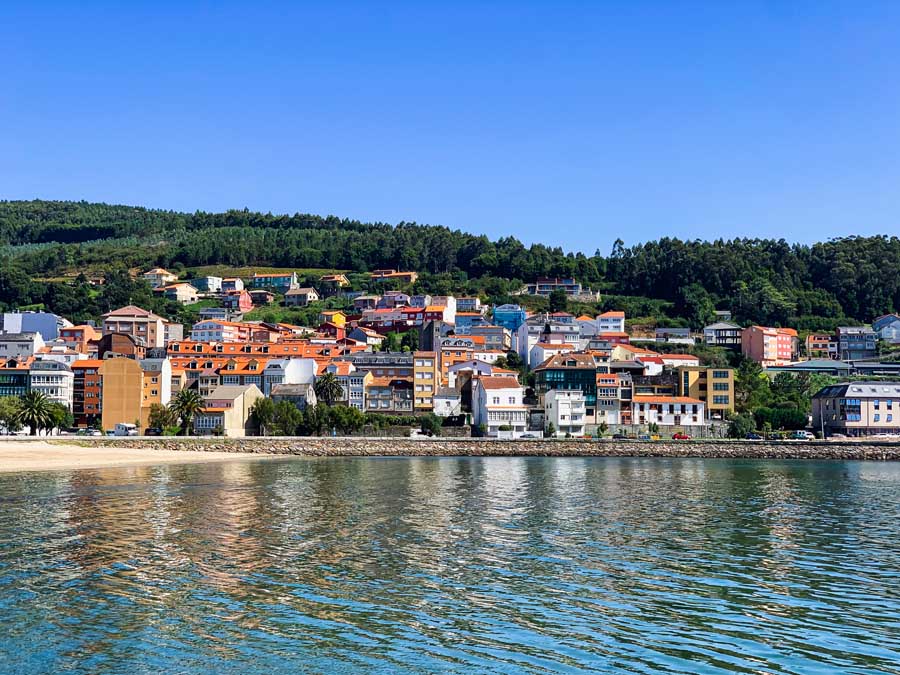
✔︎The seaside towns of Cee and Corcubión are incredibly close to Finisterre. The villages are connected via a scenic boardwalk and are worth a quick stop.
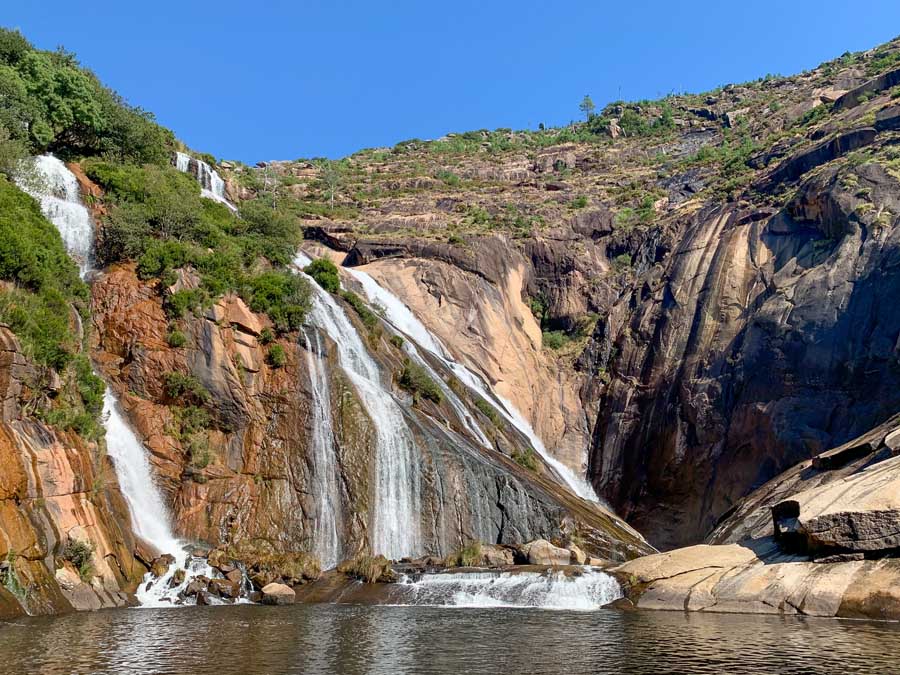
✔︎ Fervenza do Ézaro, or Ezaro Waterfall, is a scenic waterfall found along the Xallas River. The viewpoint at the top of the hillside offers sweeping panoramic views of Ezaro and Cee. On a clear day, catch distant views of Cabo Fisterra and the lighthouse.
✔︎ One of my favorite day hikes on the Death Coast is Monte Pindo. This sacred mountain is filled with myths, legends, and unique rock formations. Monte Pindo is called the “Mount Olympus of Spain.” There are many routes to reach the summit of Monte Pindo, but the out-and-back trail from O Pindo is best for those using public transportation.

✔︎ Carnota Beach is one of the most famous beaches in Galicia for being one of the longest. The stretch of white sand beach is surrounded by dunes and is a protected area. Stop in the village to see one of the largest horreos in Galicia.
✔︎ While the Romans believed Finisterre was Spain’s most western point, it is actually in Cape Touriñan. Some dispute this claim and say it’s actually in Cabo de la Nave, which isn’t that far from Finisterre.
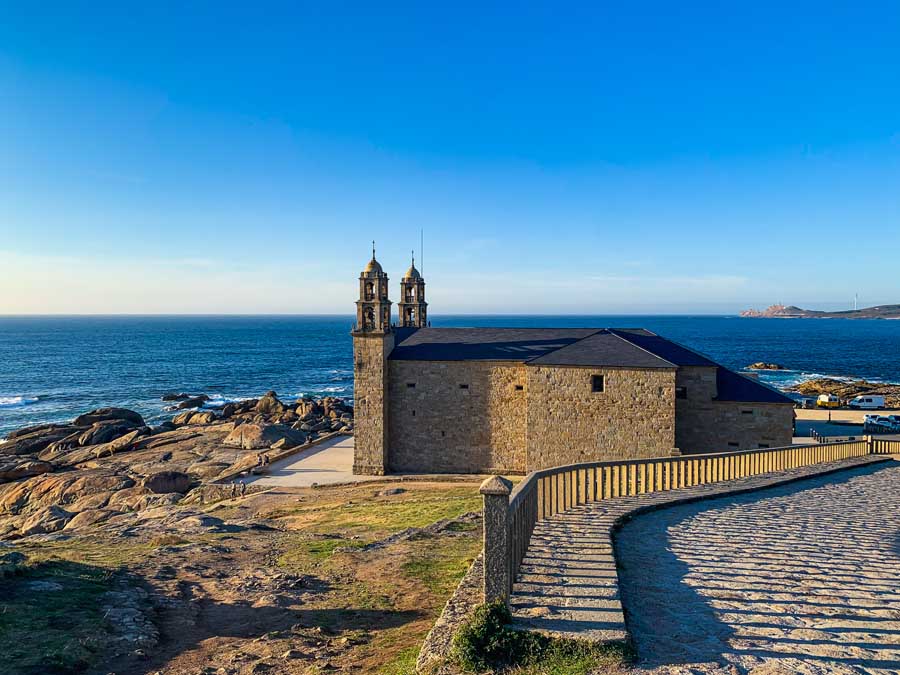
✔︎ Muxia is a much smaller fishing village on the Costa da Morte. It is also an optional ending for the Camino de Santiago. Highlights here are the Sanctuary of A Nosa Señora da Barca, views from the top of Monte Corpiño, beautiful beaches, and the nearby hiking trail of Os Muiños.
Is Finisterre Galicia Worth Visiting?

With a sacred past, a fantastic Cape, charming streets, and delicious cuisine, Fisterra is worth visiting. While there aren’t many huge iconic attractions, the village offers plenty of things to see in a busy afternoon or for a weekend getaway.
Conclusion⎟ Visiting Fisterra Guide (What to See & Do)
In short, this is a quick guide on visiting Fisterra at the End of the World. This guide offers ideas on how to best visit, what to do in Finisterre, and the best places to eat and sleep in the fishing village.
As the Death Coast is one of the most underrated destinations in Spain, I’ve also included surrounding highlights to include when visiting the fishing village of Fisterra.
Whether spending a few hours in Finisterre or slowing down to enjoy the energy, don’t skip visiting this seaside village.
Have you visited Fisterra in Galicia Spain? Is there anything you loved doing in this village that I’m missing? Let me know in the comments below!
Pack This Post for Later! Pin It!


Disclaimer: There’s a chance this post contains affiliate links, and I receive a small (but grateful) portion of the sale. There’s no extra cost to you, and I only promote things that I use and love.


