
11 Beautiful Places to See on Costa da Morte Spain’s Spectacular Death Coast
White sand beaches. Picturesque fishing villages. Rocky coastlines dowsed with mysticism. This is the Costa da Morte Spain.
Lining the shores of northeastern Spain, the Costa da Morte, or Death Coast, is an incredible place to see in the Galicia region. The area is oozing with legends from Celtic tribes that were conquered by the Romans to stories surrounding the Camino de Santiago.
In this guide, find out a brief history of the area and where is the Costa da Morte is. It also included the best things to see on the Costa da Morte, from waterfalls and white sand beaches to scenic hikes. I’ve also included some of the most beautiful villages in the Costa da Morte to see.
A majority of these Death Coast attractions focus on the areas near the villages of Muxía and Fisterra.
Here are some of my favorite places to see in along the Costa da Morte in Galicia Spain.
Table of Contents
- Where is the Costa da Morte in Spain?
- Why is it Called Costa da Morte?
- A Very Quick History of the Death Coast
- Incredible Things to Do on the Costa da Morte
- Walk the Ruta dos Faros (Lighthouse Way)
- Conclusion | The Best of the Costa da Morte Spain
Where is the Costa da Morte?

The Costa da Morte is found in the province of A Coruña in Spain’s mystical Galicia region. This blessed coastline is home to fishing villages, white sand beaches, rocky shores, and untouched rugged landscapes.
The Costa da Morte is located on the farthest western stretches of mainland Spain.
The Galicia region of Spain is privileged with a long stretch of coastline that is home to the natural landscape of Rías, or estuaries. The Costa da Morte is nestled between the Rías Baixas, (the lower estuaries) and the Rías Altas (the upper estuaries).
The Rías Baixas are located on the southwestern corner of Galicia and include the estuaries of Muros and Noia, Arousa, Pontevedra, and Vigo. To the west, find the rough seas of the Atlantic Ocean. The Rías Altas line the north shores of Galicia and stretch between A Coruña and Ribadeo. The Ría Atlas boast ten incredible estuaries and are found on the edge of the borders of the Bay of Biscay.
The Costa da Morte technically follows the rocky shoreline from Malpica to the jagged peninsula of Cape Finisterre. While the official borders of the Costa da Morte are blurry, some say the Death Coast extends all the way to the small village of Muros. The village of Muros sits on the Ría de Muros y Noia.
Why is it Called Costa da Morte?

This coastal area of the Atlantic Ocean is notorious for having strong currents and crashing waves. It’s wild and rugged.
The Costa da Morte gets its name from the abundance of historical shipwrecks that occurred between Malpica’s rocky shores to the south of Fisterra.
The Costa da Morte is said to be one of the most dangerous shorelines in the world and for hundreds of years, these rugged shores have been responsible for massive amounts of shipwrecks and sadly have claimed many lives.
Due to the dangerous coastline, one thing you can expect to see on the Death Coast is numerous lighthouses.
A Very Quick History of the Death Coast
The Death Coast is unique and has a rich history, adding to the mysticism of the area. The area was believed to be inhabited thousands of years before Christ by the Neolithic people.
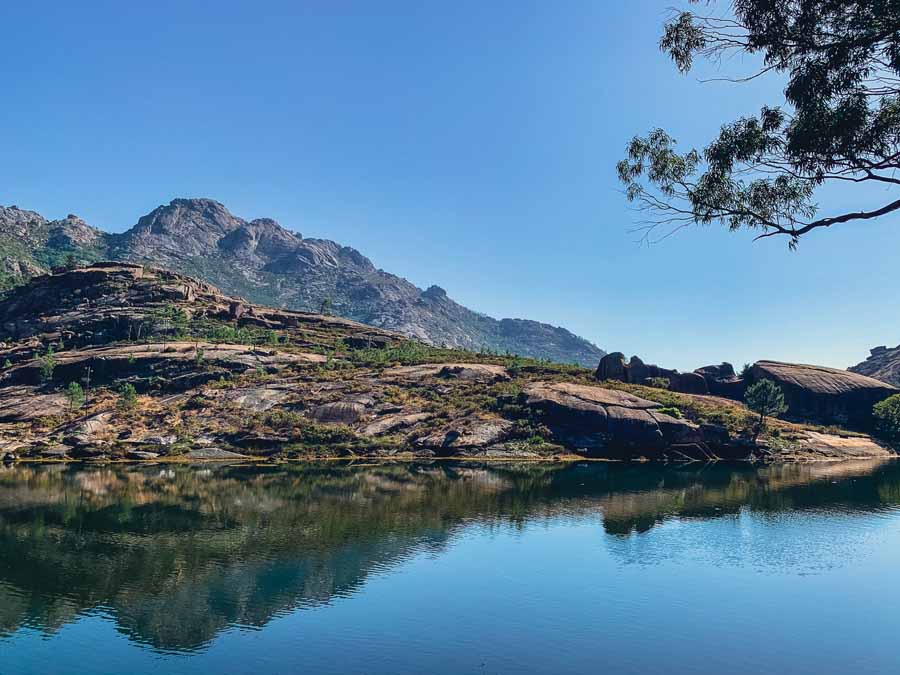
After that, the area was home to Celtic tribes and their history can be seen from megalithic dolmens to ancient hillside castros. Many Celtic tribes were believed to follow seaside paths that were believed to be fertility routes. Couples having trouble conceiving would visit women healers who lived in caves along the way following the Milky Way to the coast.
The Romans would move east on their quest for gold (Las Médulas is a prime example of what’s left of an ancient Roman gold mine) and eventually conquer the Celtic tribes. They brought Roman roads connected by advanced bridges and rulers like the mythical Queen Lupa.
The Romans believed that Finisterra was the End of the World, a place where the sun would rest behind the sea. This is why they named it Finis (end) Terrea (Earth).
With the spread of Christianity and the supposed discovery of Saint James relics, Santiago de Compostela became a medieval pilgrimage destination. Pilgrims would walk along numerous Camino de Santiago routes to stand in front of the Cathedral de Santiago de Compostela, the resting place of the Apostle James.
Some pilgrims felt called to walk to the “End of the World” and followed ancient footpaths to the sea. It was almost a baptism, to dip into the frigid ocean waters, and be reborn at the Death Coast.
Today modern pilgrims can follow the Camino Finisterre and end their journey at either the villages of Finisterre or Muxía. The walk takes anywhere from 3 to 5 days, with a full day walk that connects both villages.
11 Incredible Places to See on the Costa da Morte
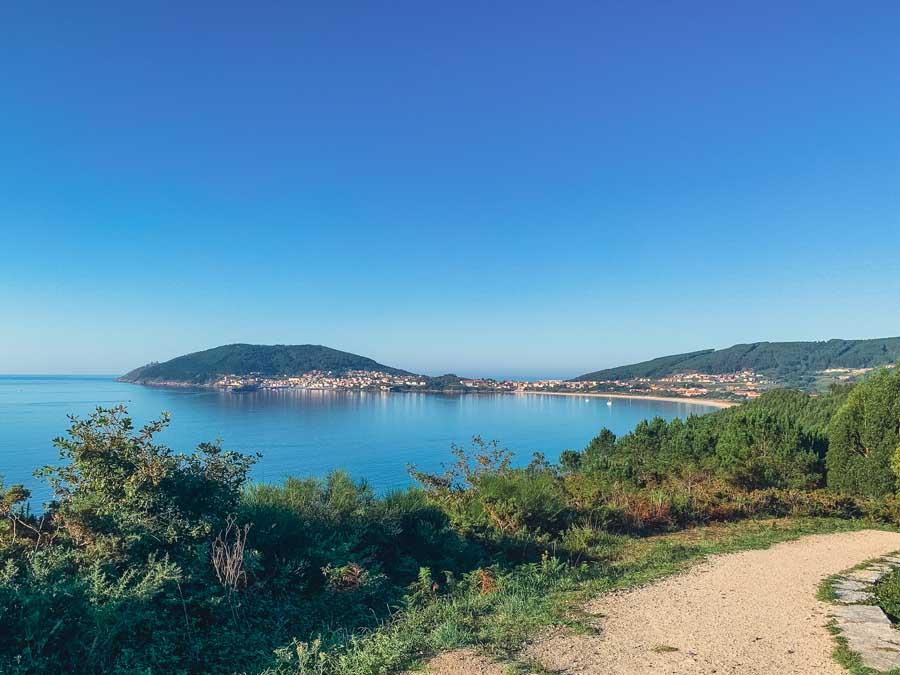
By far, the most popular places to visit on the Costa da Morte are Finisterre and Muxía. This is due to both villages having a 0-kilometer marker for the Camino Finisterre Muxía. These two beautiful villages also have a lot of infrastructure include places to stay, restaurants, and daily bus services.
As Finisterre and Muxia are beautiful villages and have things to see, they are two of the most popular day trips from Santiago de Compostela. With one day, it would be challenging to visit both villages, so it’s advised to join a Death Coast tour that showcases the highlights.
All of the following places in this Death Coast guide can be visited independently via public transportation or is found along the Camino Finisterre Muxía. Some stops are a short detour off of the main way.
This guide addresses the most popular area of the Costa da Morte between Muxía and south of Finisterre.
Here are some of the best places to see on the Costa da Morte from Muxía and beyond Finisterre.
1 | Muxía
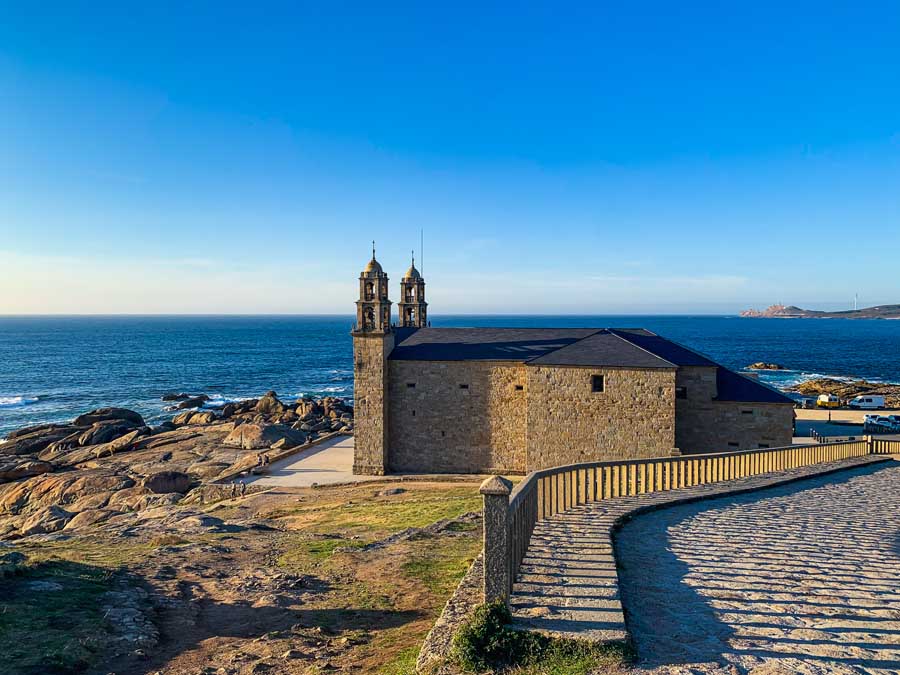
Muxía is a fantastic fishing village found along the Death Coast. The small village has a 0.0 Km marker located right before the “A Ferida” megalithic stone. This monument honors all those Galicians who came together and cleaned up after the Prestige oil tanker spilled almost 70,000 gallons of oil into the Atlantic in November 2002.
Just down on the rocky shores, find the“Santuario da Virxe da Barca” a small church that offers stunning views of the wild Atlantic Ocean. This significant chapel on the Camino de Santiago is conneted to the legend of the Apostle of Saint James. Here he was said to see the Virgin Mary materialize to offer strength and encouragement to continue on his purpose to spread Christianity through Spain.
Legends say that the stones located in front of the church are remnants of the Virgin Mary’s stone boat, including the rudder (Pedra do Timón). Many of these stones are said to possess healing powers that cure health ailments. These stones were also sacred to the Celtic tribes who lived here thousands of years before.

One of the best views in Muxía comes from Corpiño Viewpoint. The stoney hillside offers panoramic views of the sea, chapel, lighthouse, and the fishing village of Muxía.
Muxía has numerous restaurants boasting fresh seafood. There are also a few beaches steps away from the village offering turquoise waters and sandy beaches. Be mindful that the beaches on the Costa da Morte are quite frigid and can fluctuate with the tides.
As this is a popular stopping point on the Camino Finisterre Muxía, there are plenty of Muxía accommodation options from budget albergues to the only Parador Hotel on the Costa da Morte.
2 | Praia Area Maior Os Muiños

One of the best beaches near Muxía is found to the east of the village, Praia Area Maior. This sandy beach is not far from the village of Os Muiños. The most scenic way to reach the beach is to take the casual walk from Muxía.
The Os Muiños beach is a fantastic white sand beach that is surrounded by green hillsides and sandy dune. The beach sits in a cove, so the waters here are usually calmer than at nearby exposed beaches.
Another unique feature of the beach is the nearby Rio Negro that flows into the sea. Don’t miss the Senda do Rio Negro, a scenic trail that connects with Os Muiños. The forest trail boasts an old stone mill, wooden bridges, and fountains.

The path to Moraime village is also nice. Find the 12th-century stone church of San Xiao de Moraime and the 11th-century Romanesque Monastery. The monastery has recently been renovated and it’s possible to stay at the Monasterio y Pensión de Moraime.
This chapel is found on the final kilometers of the Camino route from Santiago de Compostela to Muxia.
It’s easy to spend the entire day at the Praia de Os Muiños and explore the small villages and trails nearby.
3 | Cabo Touriñán

Cabo Touriñan is only 10 miles south of Muxía but is a significant cape in Spain. While the Romans believed that Finisterre was the most western point of Iberia Spain, it is actually here in Cape Touriñan. Some say there is actually a point even farther to the west, Cabo de la Nave.
Today, there are two scenic lighthouses, and is a popular place to watch the sunset.
4 | Lires
Lires is a small village found between Muxía and Finisterre. Lires is said to be home to one of the smallest estuaries in Galicia.
The small village is close to numerous sandy beaches including Nemiña beach, Lires Beach, Area Pequena and Area Grande.
Lires has a handful of places to stay and a few restaurants. The Bar Playa de Lires has one of the most privileged views. This makes Lires a popular stopping point along the Camino Finisterre Muxía and the coastal Lighthouse Way. One of the Death Coasts most beloved hiking trails starts from Lires, the loop trail of Roteiro Meigha Lirea.
5 | Finisterre (Fisterre)


Fisterra is a superb fishing village found on the Death Coast and is blessed with many beaches. The long beach of Playa de Langosteira offers incredible views of Finisterra and one of the most popular beaches to stroll.
The Castelo de San Carlos is an old fortress that provides stellar views of the Ribeira Beach. The grounds are surrounded by a park and green space with an iconic stone cross. The old castle has been converted into a fishing museum that costs 2 Euros to visit and includes a guided tour.
In Finisterra, there are numerous places to sample fresh Galician seafood. Some of the busiest restaurants are found near Paseo Ribeira with tables spilling out into the plaza. There isn’t a bad seat in the house with spectacular ocean and port views. Nearby is the seafood market that still does a live seafood auction, which is something different to see.
Fisterra is the more popular ending point of the Camino Finisterre Muxía, making the seaside down have quite a lively vibe. There are lots of places to stay with tons of restaurants and bars. For a unique experience, head to A Galería to get some of the best views of the port in an original atmosphere.
Most people are drawn to Finisterre to see the grand Cape and lighthouse.
6 | Finisterre Lighthouse


Fisterra is often the end of the road for many with one final pilgrimage to the end of Cape Finisterre. While the lighthouse is the main draw, there are numerous trails that lead to sacred stones that were significant to the Neolithic and Celtic cultures.
The lighthouse is located around 2.2 miles from Finisterre and is where to find the 0.0-kilometer marker.
The cliffside Finisterre lighthouse (Faro de Fisterra) is a popular place to watch the sunset. The lighthouse is still active and was built in 1853. The lighthouse is around 56 feet tall, but feels more grand as it sits picturesquely on a steep cliff.
Look for monuments, crosses, and even the bronze boot statue, a tribute for those thousands of pilgrims who take the journey to the “End of the World.”
7 | Corcubión

Corcubión is another small village found along the Camino Finisterre Muxía. This is one of the final villages before walking into the grand bay that leads to Finisterre.
Corcubión has a small port, the lovely Church of San Marcos de Corcubión, and a few cafes and places to stay. The small village is connected to Cee via a scenic boardwalk stroll.
8 | Cee

Cee is a fantastic port city that is oftentimes overlooked. What I love the most about Cee is that it is an actual lived in city on the Death Coast. This town has all the luxuries including supermarkets, ATMS, pharmacies, and an actual bus terminal.
Cee is still small enough and has a few great restaurants, plazas, all while offering some great places to stay including a handful of budget-friendly albergues. The boardwalk stroll between Cee and Corcubión is a must!
While the beaches in Cee aren’t great for swimming, the bus station is well connected to the nearby villages of Ezaro and O Pindo. Between these cities find great beaches, hiking trails, and more.
9 | Ezaro Waterfall
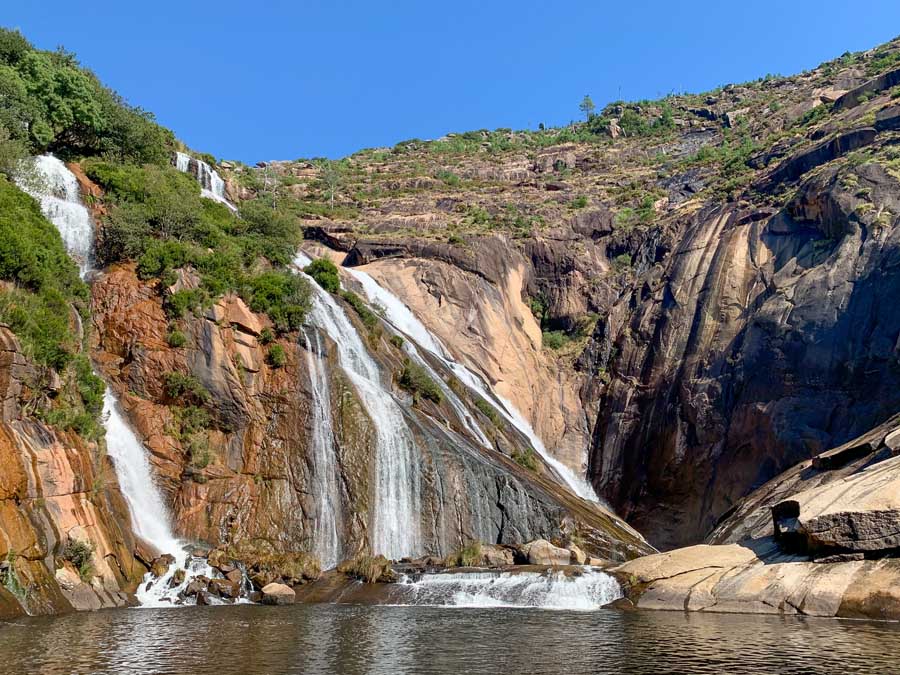
The Fervenza do Ézaro, or Ezaro Waterfall, is a scenic waterfall found along the Xallas River in the small village of Ézaro. The village itself is cute and has some spectacular swimming beaches. However, most visitors come to see the Cascada de Ezaro.
At the Ezaro Waterfall find a few shops, a helpful Tourist Information Center, a simple playground, and a public restroom. Follow the wooden boardwalk to reach the Ezaro waterfall. This waterfall is said to be significant as it is the only river on continental Europe that flows into the Ocean.
The Ézaro Waterfall is around 131 feet tall (40 m) and still provides power via hydroelectric power to the surrounding area. During the peak season at night, the Cascada de Ezaro is illuminated at night with a light show. It’s also possible to rent kayaks during the summer and paddle down the river.

Take the steep walk up to the Ezaro Mirador. On a clear day, it’s possible to see all the way to Cape Finisterra and the lighthouse in the far off distance. This viewpoint is also an alternative starting point to the Monte Pindo hike.
10 | Monte Pindo
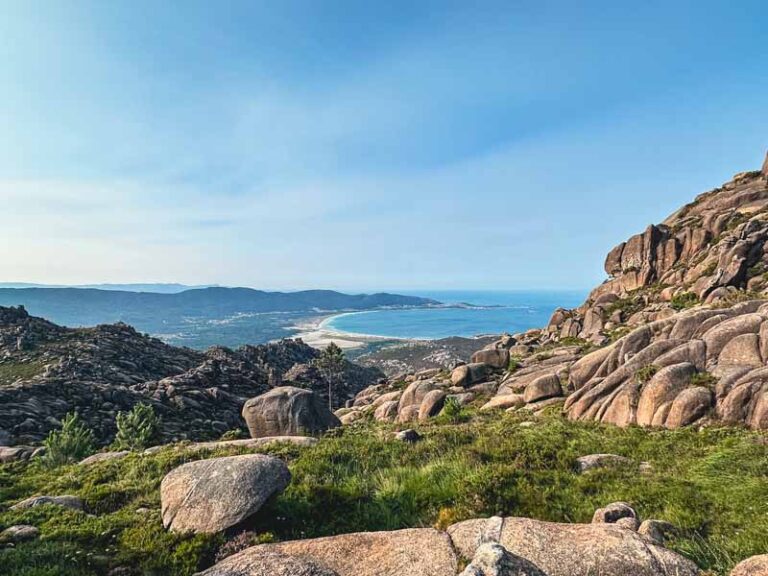
Monte Pindo is one of the most sacred mountain in Galicia. Monte Pindo is sometimes called the Mount Olympus of Spain and is filled with myths, legends, and unique rock formations. It is said that Queen Lupa is buried somewhere in the rocky stones with a hidden treasure.

The hiking trail up to the summit can be accessed from numerous locations like the Ézaro observation deck or the small village of O Pindo. The out-and-back trail from O Pindo is best for those utilizing public transportation. The hiking trail is challenging due to the rocky terrain and steep trails.
The summit is found at 2,057 ft (627 m) and is called A Moa. Find strange impressions embedded in the stones which are said to look like human molars. In Galician, A Moa translates to molars. The summit offers incredible views of the Death Coast.
Monte Pindo is one of the best hikes on the Costa da Morte.
11 | Carnota Beach

Praia de Carnota, or Carnota Beach is quite possibly the most famous and beautiful beach in Galicia. It is the longest beach in Galicia. It is shaped like a crescent moon and is almost 4.5 miles long (7 km).
Carnota Beach is blessed to be surrounded by sand dunes, marshes, and an estuary forms where a stream trickles through the pure white sand. The white sandy beach is a highlight of those traveling along the Costa da Morte and has made the list of the World’s Best Beaches (along with the Cies Islands).
Do note that dogs are not allowed on this protected beach.
In the village of Carnota, find one of the longest granaries in Spain. These historical stone granaries were known as horreos and are protected under cultural laws. The Carnota Horreo is said to be 115 ft long and was built during the 18th century.
Walk the Ruta dos Faros

One of the more unique ways to experience the Costa da Morte is to walk the Ruta dos Faros or the Lighthouse Route. The trail typically starts in Malpica and ends at Cape Finisterre. With the rocky shores of the Death Coast, lighthouses were essential in assisting sailors through the turbulent seas.
The Camino dos Faros spans 125 miles (200 Km) and takes an average of 8 – 9 days to walk. The route follows the scenic coast and passes by 8 historical lighthouses. It follows many trails and paths used by fishermen and those who gather barnacles (percebes) off the rocky shores.
Those walking the Camino dos Faros will fall in love with untouched landscapes, rugged coastal trails, and spend time on some of the most isolated beaches on the Costa da Morte.
Walking the Camino dos Faros is much different than walking a typical Camino route. As it is not an official Camino route you must plan on sleeping in guesthouses, hotels, and local lodges. There is also no credencial or pilgrim passport.
The route is unofficially run by a non-profit “Camiño dos Faros Association” who provides tons of useful guides and maps. Volunteers have also marked sections of the trails with green arrows, but some trail sections can be hard to follow or are overgrown.
The Ruta dos Faros is the perfect off the beaten path adventure for those seeking to delve deeper into the beauty of the Costa da Morte.
Conclusion | The Beautiful Costa da Morte Spain

In short, this is a quick overview of the best places to see on the Costa da Morte, Spain’s Death Coast.
As most travelers visit the Costa da Morte as part of their Camino de Santiago journey, this guide focuses on highlights near the popular ending points of Finisterre and Muxía. However, it would be easy to combine the Death Coast on a road trip through Galicia.
This short guide also includes where the Death Coast is located in Spain and overview of the history of the region.
From beautiful villages on the Costa da Morte, white sand beaches, and spectacular hiking trails, the Death Coast of Spain is worth visiting. In my heart, the Death Coast is one of the most underrated regions in Spain.
Don’t miss a chance to slow down and spend time exploring the Costa da Morte.
Have you visited the Costa da Morte in Galicia Spain? What were some of your favorite places to see? Is there any place along the Death Coast that you loved and I’m missing? Let me know in the comments below!
Pack This Post for Later! Pin It!


Disclaimer: There’s a chance this post contains affiliate links, and I receive a small (but grateful) portion of the sale. There’s no extra cost to you, and I only promote things that I use and love.