

Visit Castro Lupario the Mythical Fortress of Queen Lupa
There is a noticeable change when pilgrims reach Galicia Spain. The language changes along with the culture. The rugged Atlantic Ocean blows off in the far distances, the coastline is lined with Rias (estuaries), and the mountains are usually misty and covered in fog.
Galicia feels more like their distant Irish neighbors to the north across the Celtic Sea than Spain.
Galicia has deep roots with Celts and long before Christianity spread to Spain, this area was home to Pagans who were deeply connected to the stars and the land.
One name that comes up in this region is Queen Lupa. She was said to rule over the untamed lands of present-day Galicia. She was rumored to live at the top of the mountainous hillsides of Galicia in Castro Lupario.
If you’ve walked the Camino de Santiago there is no doubt that you’ve heard of the Pagan Queen Lupa.
This is a quick guide on how to visit Castro Lupario, her legendary Fortress near Teo Spain.
Table of Contents
Disclosure: This is part of my Hikes & Adventures series, which means these treks can be strenuous and challenging. These are my experiences and I am not an expert. Please have all the proper equipment, verify the weather conditions, use professional resources, do your own research, be mindful of constantly changing trail conditions, and take into consideration your own physical abilities and/or limitations. These guides are for entertainment purposes only. Please see my full disclosure for more information here.
- Who is Queen Lupa?
- Castro Lupario Detour on the Camino Portugués
- Map & Overview of Castro Lupario Hike
- How to Visit Castro Lupario
- Queen Lupa’s Fortress
- Conclusion | Visiting the Mythical Castro Lupario
Who is Queen Lupa?
I had first heard of Queen Lupa after I walked my first Camino de Santiago route, the Camino Frances. I heard even more about her after walking the Camino Finisterre Muxia.
So I tried to find out more information about her and I came up empty-handed. I asked local Galicians and tour guides about her, but no one had any solid information, just stories.
Some say she is only a mystical figure, more of a fabricated pawn that the church used to help spread Christianity. Other accounts say she was real and she was revered as a Pagan goddess with ties to the Galician aristocrats.
But, if you’ve walked any Camino de Santiago route, Queen Lupa is a significant person who coincides with the story of Saint James.
Saint James supposedly came to Iberia to spread the word of Christianity. The area under the reign of Queen Lupa was part of the Roman pagan lands that were unresponsive to the teachings of Jesus.
The Apostle James returned to the Holy Land, where he was beheaded in 44 AD by King Herod. James was the first apostle to be martyred, and his loyal disciples, Theodore and Athanasius, took his body on a stone boat to sail back to Iberia. These stories are documented in the Codex Calixtinus, five manuscripts that include miracles, and are kind of like the first-ever unofficial Camino de Santiago guidebook.
Theodore and Athanasius found themselves on a stone boat that sailed up the River Ulla. The boat tied up to a stone mooring at Iria Flavia (Padrón). Modern-day pilgrims can follow this Way of the Cross via boat as part of the Variante Espiritual Camino route.

Again, there are multiple legends of what happened, but Theodore and Athanasius seek help from Queen Lupa to assist with burying the remains of Saint James. She was said to live in Castro Lupario at the top of the mountain. She deceived them not once, but twice.
The most well-known story is that Queen Lupa sent them to Mount Ilicino, which is today known as Pico Sacro (that is part of the modern-day Camino de Invierno). She had sent them to the mountain to find what they needed for the burial of Saint James, but it would turn out to be a devious trick.
Upon arrival, they were met by a dragon that came out of the depths of the cave, but miraculously, they were able to defeat the creature. Next, the oxen turned out to be wild bulls, but again, the faithful disciples were able to tame the wild beasts. They returned to Queen Lupa, who was so surprised to see them alive that she converted to Christianity. Or so the story goes.
While there is little written about Queen Lupa, it is said that she ruled the land of Finisterre. She often plays the role of the villain; however, many strong and independent women are written into these roles in the Bible and multiple religious texts.
I became intrigued by her and felt she was misunderstood or was designed into a character by the Church. Or maybe I felt more empathy for her, a wild woman who didn’t want to conform. Whatever the reason, whenever I see a detour with her name, I always take it.
This is what led me up to Castro Lupario, Queen Lupa’s once magnificent fortress.
Castro Lupario Detour on the Camino Portugués


Castro Lupario is found between Padrón and Santiago de Compostela on the Camino Portuguese Way. The closest village is Teo, which has a Xunta Municipal Albergue. Teo is only around 9 miles from Santiago de Compostela.
Queen Lupa’s Fortress is around a 2.5-mile round-trip detour from the Albergue. It didn’t take long to explore, but I spent the afternoon at the hilltop savoring the views, writing in my journal, and soaking my feet in the Rio Tinto near the Ponte Paradela bridge.
Drop your bag at the Albergue and reflect on the journey of the Camino in silence at the mountain top before arriving in busy Santiago de Compostela.
Castro Lupario Map & Hike Overview


- Out & Back Trail
- This map follows the out-and-back trail from the Xunta Teo
- Official Trail Markers: yellow and white rectangles (Blazes), with some wooden signboards
- Difficulty: Moderate, it’s towards the end of the Camino Route so it doesn’t seem so tough
- Do not attempt in bad weather and be mindful that the fortress is unmarked at the top
- Distance Teo Albergue to Castro Lupario One-Way: Around 1.25 Miles (2 Km)
- Distance Out & Back: 2.5 Miles(4 Km)
- Excursion Duration: +/ – 2 hours, depending on how much you wander the site
- Essentials for Visiting Castro Lupario
- First-Aid Kit
- Small Day Hiking Backpack
- Water in a Reusable Water Bottle
- Trekking Poles if you love them
- Offline Castro Lupario Map from some source
- Extra Battery Pack for electric devices
- These are all items included in my Camino Packing List
➯ Hey… don’t forget your Travel Insurance! I love SafetyWing
How to Visit Castro Lupario


Follow the yellow arrows until Rua do Frances. I took a quick detour one street over because I knew I would walk past the Capilla de San Martín and one of the oldest stone crosses in Galicia, the following morning, to Santiago.
The way passes by the green park of Carballeira de Francos. At this park, you’ll want to merge off the official path and take the road Aldea Beca. It’s a paved road and look for house 56. Keep the house to your left and walk on the road. This is a car road, so make sure to walk on the left side of the road for safety.
Not far on the road, catch those first glimpses of the large hill where the ruins are. Keep walking and to the right, see a small park with the stone bridge of Ponte dos Mouros. The Rio Tinto offers an inviting rest stop before or after the hike.
There is an official Galician signboard of the route. The Fortress is part of a larger circular route and is marked by yellow and white blazes. This local trail is marked Ruta do Castro Lupario Rois -Brión. There are also wooden signboards to direct hikers up to the Castro.

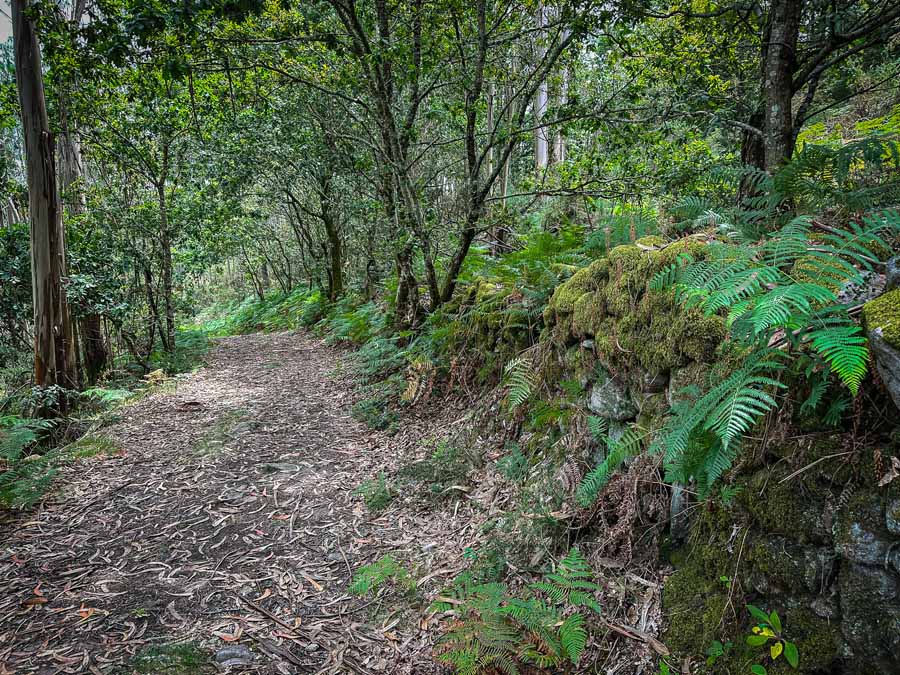
Cross the modern-day bridge of Ponte de Paradela. Look for the trail on the left-hand side of the road. The trail is obvious and delightful. Walk to the wooden signboard that indicates the direction of Castro Lupario and begin the uphill climb.
As I had already walked quite a bit, I walked up to the fortress and only followed a small section of the trail to Angueira de Castro, where I could get different views of the ruins. The hiking trail is lovely and cuts through the trees.
Queen Lupa’s Fortress
There really isn’t much left of Queen Lupa’s once-powerful fortress. You kind of have to use your imagination as you move through the overgrowth. On that note, there is no signage at the top. The terrain at the top is stony, and some sections are overgrown, so mind your footing.
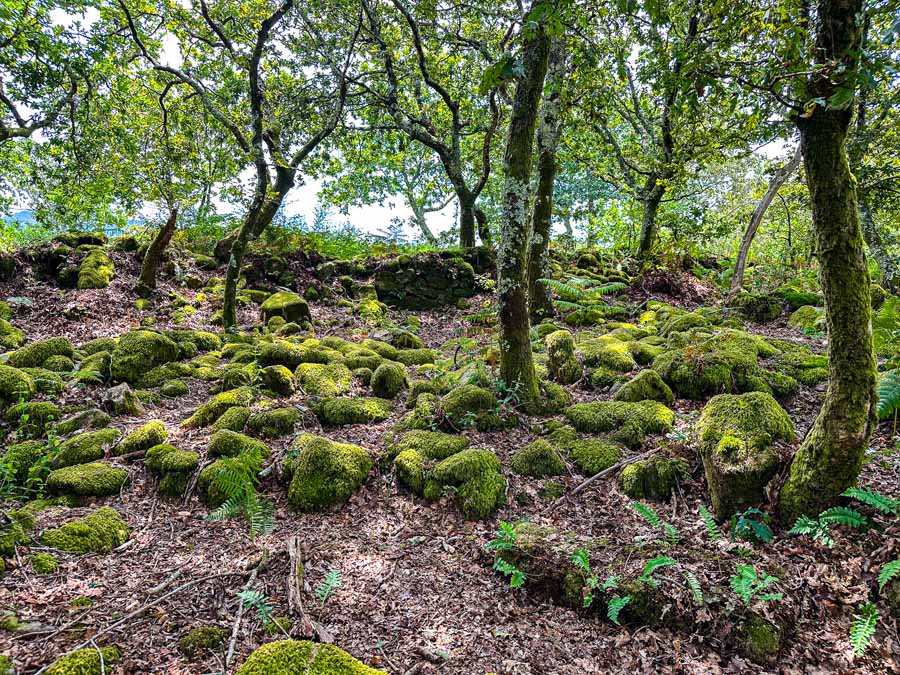
In the trees, there are tons of large stones left in despair. The stones are covered in moss as if being reclaimed by the Earth.

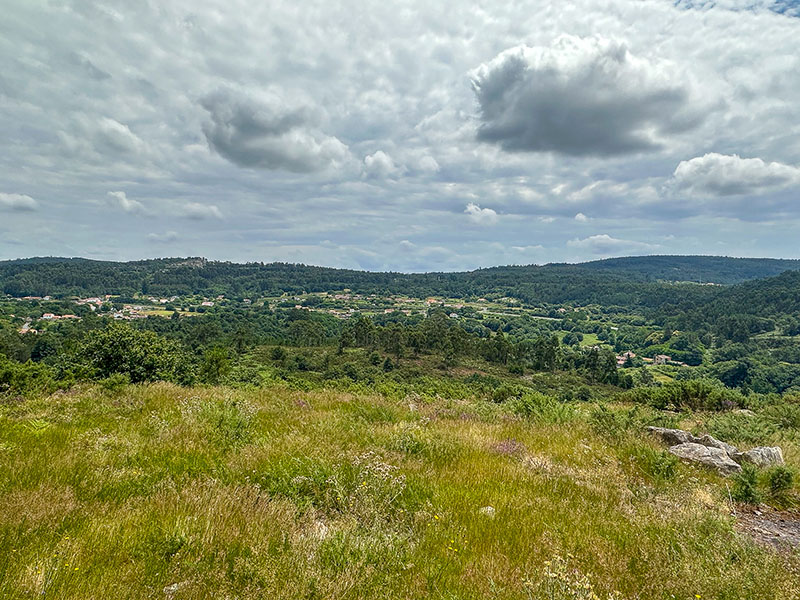
There is a large section of wall that remains intact. I made a loop and perched myself on a rock and savored the views from the mountaintop. It’s almost as if I could imagine her gazing off over her lands from here.
Queen Lupa was said to have kept bulls and wolves onsite for her pagan rituals, but again, most of her history has been lost or maybe fabricated. We can only sit here and listen in the silence.
On the day I visited, it was the summer equinox, and it felt fitting to be sitting in the ruins of a Pagan Queen. While the ruins here won’t blow your mind, maybe the energy will transcend you.
When finished, return on the same path back to Ponte dos Mouros. I had this place to myself, so I took off my shoes and soaked my feet in the Rio Tinto. There is also a picnic table here. It was a perfect afternoon.
I slept at the Xunta Albergue of Teo, but Albergue La Calabaza del Peregrino is before the Xunta, and Casa Rural Parada de Francos is near the park but requires reservations.
Conclusion Visiting the Mythical Queen Lupa’s Fortress

In short, this is a quick guide on how to add Castro Lupario, the fabled residence of Queen Lupa, to your Camino de Santiago route.
Little is known about Queen Lupa, including whether she was a mythical character or a real-life goddess. One thing is for certain: she maintains a strong presence on the Camino de Santiago. While there is little to see of her fortress, the views and energy are worth the hike.
If you’re like me and become intrigued by Queen Lupa, you can follow her to Cee Spain where it’s possible to hike up Monte Pindo. Queen Lupa is said to be buried on Monte Pindo, which is one of the most sacred mountains in Galicia.
Did you add the Castro Lupario detour to your Camino Portuguese? What did you think? Are there any updates to the trail? Let me know in the comments below!
Pack This Post for Later! Pin It!
Disclaimer: There’s a chance this post contains affiliate links, and I receive a small (but grateful) portion of the sale. There’s no extra cost to you, and I only promote things that I use and love.


