

The Ultimate Guide for the Variante Espiritual Camino Route & Why It’s Worth It (2026)
One of the most popular Camino de Santiago routes is the Camino Portuguese. The Variante Espiritual or Camino Spiritual Variant is an optional route on the Camino Portuguese just after the city of Pontevedra in Galicia, Spain.
Pilgrims who choose to walk the Camino espiritual route will find themselves walking past beautiful seaside villages, ancient monasteries, and along some of the best hiking trails in Galicia.
This scenic route is walked over three stages, with the final stage including a boat ride from Vilanova de Arousa in the estuary of Ria de Arousa.
The Variante Espiritual Camino de Santiago route sees fewer pilgrims, as it is a little longer than the standard Camino Portuguese route. However, the route oftentimes becomes a highlight of the entire route.
Whether you follow the Spiritual Variante as a religious or spiritual path, this detour will leave you in awe of the tranquil nature and may offer a way to connect to your deeper self.
This Variante Espiritual Camino guide includes my personal tips, my Spiritual Variante stages with GPX files, and useful information on the boat companies for the final day on the Way of the Cross.
Here’s my complete guide on the Camino Variante Espiritual and why it’s worth the walk.
Table of Contents
- Overview of the Camino Espiritual
- Typical Spiritual Variant Camino Stages & Distances
- Camino Espiritual Frequently Asked Questions
- Useful Planning Tools for the Camino Espiritual Route
- Pontevedra Spain, The Last City Before the Camino Espiritual Route
- My Personal Spiritual Variante Camino Stages
- Useful Boat Information for the Camino Variante Espiritual
- My Personal Budget for Camino Espiritual Route
- The Camino Stages After the Spiritual Route
- Conclusion ⎥The Ultimate Camino Variante Espiritual Guide & Why It’s Worth Walking
Overview of the Camino Espiritual
The Variante Espiritual Camino route is found towards the final stages of the Camino Portuguese. If walking from Lisbon or Porto, you’ll have plenty of time to decide if you wish to add this variant to your Camino route.
The Camino Espiritual detour route comes right after the bustling medieval city of Pontevedra, Spain. The historic city center is filled with charming little plazas, museums, and churches, making it a popular city to sleep on the Camino Portuguese.
From Pontevedra, the standard Camino Portuguese route along the Central Route to Padron is around 25.7 Miles (41.3 KM).
The typical stages of the Camino Portuguese are Pontevedra ➜ Caldas de Reis ➜ Padrón ➜ Santiago de Compostela
The Variante Espiritual route is one of the more popular alternative routes on the Camino Portuguese.
The Camino Espiritual is typically two days of walking from Pontevedra to Vilanova de Arousa. On the third and final day, most pilgrims opt to hop on a boat in Vilanova de Arousa to experience the Way of the Cross or Via Crucis Maritimo-Fluvial.
The Camino Espiritual, the route will be around 28.5 miles (46 KM) on foot and 17 miles via boat ride. The official boat ride is said to span 28 KM. Boats drop in Pontecesures, where it’s a quick walk to rejoin the Portuguese Way in Padron.
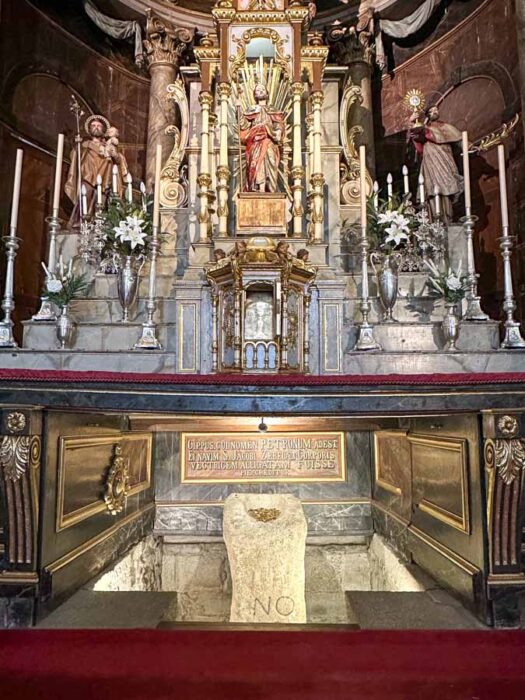
Padrón has such a significant history with the Camino de Santiago for two reasons. First, it is said that Saint James arrived here in Spain to spread the word and teachings of Jesus. The second and most commonly mentioned story of Padrón is that it is believed to be where the Apostle Saint James’ body was returned to Spain after he was beheaded in Jerusalem.
His “stone boat” was tied up to a mooring post in Iria Flavia. Of course, the legends continue of how his body was buried and hidden, only to be discovered in the 9th century, to be buried underneath the towering Cathedral of Santiago de Compostela.
Camino Variante Espiritual Stages & Distances

The Camino Spiritual Variante stages are typically walked over three days.
The Variante Espiritual way is around 27 miles (43.6 km) of walking and a boat ride that takes a little over an hour. The walk and boat ride spans over three stages. This route takes around three days, but of course, it’s possible to slow down and stay in small villages along the way.
The Variante Espiritual route is well-marked with yellow arrows in the shape of the famous conch shell. Find the yellow arrows in concrete blocks, on the side of walls and homes, on trees, and sometimes spray-painted on the road.
The Camino Spiritual Route also has its very own signposts made from wood with silver markings.
There are two typical routes for the Spiritual Variant of the Portuguese Way. Both routes follow the same path until Vilanova de Arousa, where pilgrims can decide to take the maritime way via boat or walk along the coast to Padrón.
The Spiritual Variant Camino route has fairly good infrastructure that includes albergues and villages with all the main services, like cafes, laundry facilities, and more.
Camino Espiritual Variante Stages & Distances with Boat
The most common way to complete the Camino Espiritual is two days of walking and the final day by boat.
The official signboard from the trailhead near Pontevedra reads 43.6 KM (27.1 miles) to Vilanova de Arousa.
- Day 1 | Pontevedra – Armenteira | 12.4 Miles / 20 KM | + / – 5 Hours
- Day 2 | Armenteira – Vilanova de Arousa | 14.7 Miles / 23.6 KM | + / – 6 Hours
- Day 3 | Vilanova de Arousa – Padron | Via Boat 28 KM | 1.5 Hours
Camino Espiritual Stages & Distances by Foot
The Camino Espiritual can also be done completely on foot with no boat ride. Be mindful that on Day 3, from Vilanova de Arousa to Padron, there are limited services and the mileage is long. The route from Vilanova de Arousa to Padron on foot is not common, and some sections of the trail may be poorly marked or even overgrown.
Those who have actually walked the final day of the Camino Espiritual say it is absolutely not worth it. However, this is all hearsay, as I have not actually walked it myself. Each pilgrim will choose the way that calls to them.
- Day 1 | Pontevedra – Armenteira | 12.4 Miles / 20 KM | + / – 5 Hours
- Day 2 | Armenteira – Vilanova de Arousa | 14.7 Miles / 23.6 KM | + / – 6 Hours
- Day 3 | Vilanova de Arousa – Padron | 18.6 Miles / 30 KM | + / – 9 Hours
This Most Important Advice on Walking Any Camino Route

Remember, the Camino is all about the journey and not the destination. There is no right or wrong way to walk the Camino. The way always has this peculiar manner of providing exactly what each of us needs, even if it isn’t what we were expecting.
Let go of judgments of yourself and others as you walk. It’s the best way.
Always walk your own walk, stay on the trail, listen to your body, pack light, and let the magic of the way unfold before your eyes. Be respectful of the sacred path and the locals who allow us passage. These are also some of my best Camino de Santiago tips for first-time walkers.
Show kindness to fellow pilgrims by wishing them a “buen camino,” which means good walk, good way, or good path. It’s the common greeting along the way.
Always walk your own Camino, on this journey, and in your life.
Camino Spiritual Variant Frequently Asked Questions
Here are some of the most frequently asked questions about the Spiritual Variant route on the Portuguese Way.
What Camino Route is the Variante Espiritual On?

The Variante Espiritual route is part of the Camino Portuguese route. In fact, this route is oftentimes called the Spiritual Variant of the Camino Portuguese Way. The entire stretch of the Spiritual Variant is located in Galicia, Spain.
Where Does the Camino Espiritual Start?
The Camino Espiritual starts less than 2 miles (3.2 KM) after Pontevedra, Spain. All pilgrims following the Camino Portuguese will depart Pontevedra via the Ponte do Burgo footbridge. The route continues to the small hamlet of Pontecabras.
Once in Pontecabras, those opting for the variant route will cross over the Ria da Gandara. There is an official signboard that marks the way.
Will Taking the Boat on the Variante Espiritual Disqualify Me for a Compostela?

Many pilgrims worry about being disqualified for an official Compostela if walking the Camino Espiritual. Remember, a Compostela is an official certificate that you can receive in Santiago de Compostela for walking at least a minimum of 100 KM to Santiago.
☛ Make sure to always collect two daily stamps on any Camino route
Most pilgrims opt to take the boat on the final day of the Spiritual Variant. Some people say they have been denied their Compostela for taking the boat. However, the boat is officially part of the route. It is said to follow the actual route that Saint James’s boat took to return to Spain. It is the only official maritime path on the Camino de Santiago.
The official term for moving Saint James’ body via the stone boat is referred to as the traslación, and the boat follows the same alleged path. Those walking the Camino Espiritual are literally taking the way of the final way of the Apostle James.
Those pilgrims who started their Camino Portuguese from Porto should have absolutely no issues receiving a credential. Even pilgrims who started their Camino journey in Tui are walking at least 114.5 KM.
Personally, I started my Camino in Porto and took the boat on the final day of Camino Espiritual. In Santiago, I had no problems or doubts about receiving my Compostela for the Camino Portuguese.
The boat companies have a stamp for the credential (or pilgrim passport). Those who are walking the Camino Espiritual and are extremely nervous about the Compostela and kilometers can opt to decline the stamp.
Where Does the Spiritual Variant Rejoin the Camino Portuguese?

The Variente Espiritual rejoins the Camino Portuguese in the small industrial town of Pontecesures. Exit the boat and cross over the Ulla River. Once I crossed the bridge, I saw my first marker for Santiago. The official marker read 27.88 KM (17.3 miles) to Santiago de Compostela.
From Pontecesures to Padron is only a 30-minute walk and around 1.5 miles (2.4 KM).
How Many Days Does it Take to Walk the Camino Espiritual?
Typically, the Camino Espiritual takes 3 days to walk. If the tides and timetables are right, it’s possible to take the boat ride in the afternoon of Day 2. Boats are almost always in the morning.
Vilanova de Arousa is a nice seaside town with sandy beaches, so some pilgrims may opt to take a rest day here to enjoy the tranquil beaches.
Some pilgrims opt to sleep in Combarro, which is between Pontevedra and Armenteira. This will take pilgrims at least 4 days to complete the Spiritual path.
Is Walking the Camino Espiritual Worth it?
Yes, walking the Variante Espiritual route is absolutely worth it. Although it is a small detour and adds an extra day or two, the Camino Espiritual is often a highlight of the Portuguese Way.
The picturesque route includes lovely coastal villages, captivating monasteries, stunning trails, old stone water mills, small waterfalls, and an enjoyable boat ride past ancient stone crosses.
Useful Planning Tools for the Variante Espiritual
Are you a guidebook pilgrim or one who loves apps?
For me, I loved carrying my John Brierly book for the Camino Portuguese, which includes the Variante Espiritual. The book is A Pilgrim’s Guide to the Camino Portugues and has the route from Lisbon to Porto and the alternative routes from Porto (Coastal, Litoral, and Central).
If you don’t want to carry a guidebook, some popular Camino Apps include:
- Camino Ninja App (Free)
- Wise Pilgrim ($4.99 for the Camino Portugués)
- Gronze.com has excellent information for the Camino Portuguese
- Booking.com is an excellent resource for securing private albergues, casa rurals, pensions, and accommodations along all of the Camino Routes
- Maps.me is a great offline map
- I record all my routes with Wikiloc
- Google Translate can come in handy if in a pinch
- WhatsApp is useful for contacting the boat companies in Vilanova de Arousa
➜ These are all my favorite Apps when walking the Camino de Santiago
Other Online Sources
- Join the Private Camino de Santiago 2025/2026 Facebook Group for up-to-date information
- TuiTrans can transfer backpacks along the Camino Portuguese and the Variante Espiritual, and all can be arranged online, via WhatsApp, or at the Albergues. Daily transfers start around €6.


Pontevedra Spain⎥ The Last City Before the Spiritual Variant
Pontevedra was a surprise, and I found this underrated Spanish city to be quite authentic and full of life. The city is blessed with a bustling food scene, free museums, tons of plazas, a fun local market, and it’s a University town.
There are a lot of things to see in Pontevedra, so many pilgrims take a rest day here.
Most pilgrims opt to sleep in Pontevedra the night before embarking on the Camino Espiritual. This is because it’s the closest city right before the detour route.
There is a municipal Albergue, the Albergue Virxe Peregrina, on the outskirts of Pontevedra. Be mindful that it is quite a way from the historic center of Pontevedra, so if you want to soak in the atmosphere of the city, I don’t necessarily recommend staying there.
This is a Municipal Albergue run by the Xunta of Galicia, so they don’t allow reservations.
Albergue Virxe Peregrina | Find it Here | Municipal Albergue | 56 Pilgrim Beds / €10 with Pilgrim Credencial Required | Open: 13:00 – 22:00 with curfew enforced at 22:00
Pontevedra Hostels Near the Historic Center
These are highly rated hostels in Pontevedra.
- Acola Hostel (I stayed here and loved the location)
- Dpaso Urban Hostel
- Albergue Aloxa Hostel
- Slow City Hostel
- Turoqua Hostel
- Hostel Charino
Pensions and Private Rooms in Pontevedra
➜ Browse all the Best Places to Stay in Pontevedra Spain
My Personal Variante Espiritual Camino Stages
This is my personal route for the Camino Espiritual. My situation was a little different, as there was an abnormally large group of 40 schoolchildren walking the Variante Espiritual route at the same time as me.
Due to this, I slept a little off the typical stages.
Jump to | Day 2 | Boat Information | Day 3
Day 1 | Pontevedra – Barrantes (Ribadumia)
- 18.28 Miles / 29.4 KM | + / – 8 Hours
- Accommodation: Hospedaje Rústico – Restaurante Os Castaños | €35 with a hearty breakfast included

Day 1 highlights of the Camino Espiritual include: the Monastery of San Juan de Poio, the picturesque village of Combarro, climbing up the hillside to the Loureiro viewpoint, and the Monastery of Santa Maria of Armenteira.
While most pilgrims opt to sleep in Armenteira, I continued farther onto arguably the most stunning section of the Variante Espiritual, the Ruta da Pedra e da Auga.
Depart Pontevedra
Follow the waymarkers at the detour from Pontevedra. One thing about this route is that there are many tiny churches scattered about on the first day.
One of the first points of interest on the Camino Espiritual is the Mosteiro de San Xoán de Poio. If you wish to visit the interior of the monastery, you’ll have to arrive after 10:00. The Monastery is known for its stunning mosaic mural and depiction of the Camino Frances route.
It’s possible to sleep at the Monastery as well.
Monastery of San Juan de Poio | Find it here: Rúa Convento, 36995 Poio | Hours: Daily, 10:00 – 13:00 & 16:30 – 19:30, closed Sunday mornings and on festivals | Admission Fee: €2.50
Unfortunately, the Monastery was closed, but the City Hall (which offers a stamp for the Credencial) told us to ring the doorbell to see if they would accept visitors early. No luck.


Don’t miss the incredible hórreo in the back. The hórreo found at the Poio Monastery is said to be one of Galicia’s longest hórreos at an impressive 33 meters (108 ft).
Horreos can be found throughout Asturias and Galicia and were used to help store grain. The ones found throughout Galicia are iconically made from stone and can be seen throughout the region. It’s been said that Galicia boasts over 30,000 horreos, some dating as far back as the 12th century.
Combarro Spain
The way continues downhill towards one of the most picturesque villages in Galicia, Combarro. Located along a beautiful stretch of the Ría de Pontevedra, the small town has an almost magnetic feel. If you love the village, there are plenty of opportunities to stay in Combarro.
Galicia is home to many Rias or estuaries. One mystical theory states that the many estuaries are the finger marks left behind by God after creating the world. He placed his hands to rest, and the estuaries were formed.
Another reason this route is considered the Variante Espiritual is due to the obvious beauty and connectivity to nature. With deep Pagan roots, Galicia has many ancient legends and myths linked to the Earth and its elements.

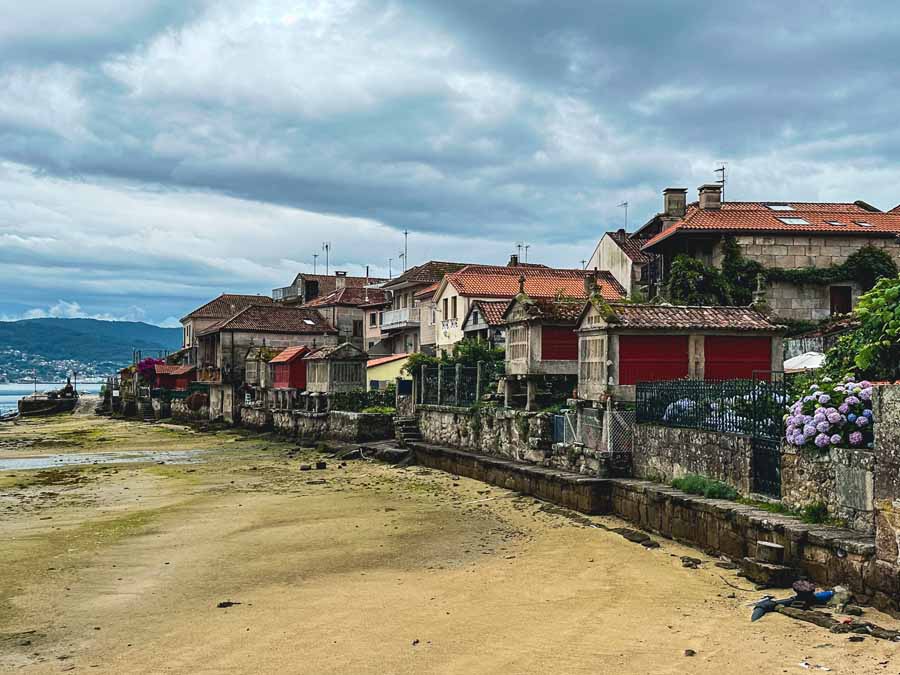
Combarro is known for its many seaside hórreos and is home to over 30 standing horreos. What makes Combarro unique is that many of the horreos are located directly on the seashore.
When the tide is high, it can appear as if the horreos are floating above the sea. There are also numerous cruceiros, the famous double-sided stone crosses typically found throughout Galicia and northern Portugal.
Combarro has lovely small plazas, delightful cobblestone streets, and lots of restaurants and tapas bars offering the freshest Galician seafood.
One thing is for certain: Combarro is still very much connected to the legends of Miegas. Miegas are considered “good witches,” many of whom offer protection and are considered wise healers. In Combarro, many small shops sell handicrafts from Miegas or pay some kind of homage to them.
For all of these reasons, Combarro is a popular place to stay and slow down along the Spiritual Route.

Sadly, it will be time to leave Combarro and head uphill. Remember, if you visit the village, you’ll have to return to the way to Fountain Square. Before departure, if you didn’t eat, make sure to stock up on food or snacks, as the next part is pretty steep and there are no cafes to stop until Armenteira. The grueling climb is quite tough up to Miradouro do Loureiro.
I had quite a bit of rain, but was still able to appreciate the views. Make sure to look back and savor the final views of the estuary.
Miradouro do Loureiro offers a small place to rest with stellar views. However, it’s still 5 KM to Armenteira, and the tallest point for the day at almost 1,500 feet is still to come.
There are many trails in this section, so be mindful and more conscious of the signposts. It’s never a bad idea to check in with an offline map if unsure. I found someone who had been separated from their group and wandered just a tad bit off-path, making them quite frantic. Be present and mindful of the arrows.
Armenteira

The small village of Armenteira is where most pilgrims opt to sleep for the night. The small village is where the delightful riverside trailhead of Ruta da Pedra e da Auga begins.
Armenteira has a mystical monastery in the village that offers a nightly pilgrimage blessing by the nuns at 19:00. The monastery is intended as a place to reflect and stay for a few nights; however, if there are open rooms, they may allow pilgrims to stay for one night.
There are quite a few restrictions on when it’s possible to sleep at Armenteira Monastery, so it’s best to contact them directly
There are two bars/cafes in the village.
Armenteira has the established Albergue San Ero A Armenteira. While the signboards, most guidebooks, and the actual building all have a plaque reading Municipal Albergue, the Albergue in Armenteira accepts reservations, so it’s typically booked out.
The entire group of 40 students rented the Albergue De Peregrinos Armenteira. Normally, this wouldn’t be an issue, but it may be best to book in advance if set on staying in the village of Armenteira.
Albergue San Ero A Armenteira | Find it here: Lugar a Vilar | Pilgrim Beds: 17 / €10 | Open: Year round with the doors opening at 13:00 and closing at 22:00 | Credencial Required & Allows Reservations
Additionally, there are a few places to stay in Armenteira. Lodging has always been a problem on this stage, so there are more options popping up.
➜ Albergue Caroi Hostel & Rooms Armenteira is a new accommodation option with private and shared rooms.
➜ Pousada Armenteira is an expensive treat to stay at in Armenteira.
Now, outside of town, there are a few more accommodation options in Valboa. This is around a 15-minute walk from Armenteira.
➜ Albergue Armenteira is a small albergue outside of Armenteira.
➜ Albergue Turistico En Armenteira A Fragua do Ferreiro has private and shared rooms with warm hosts.
Ruta da Pedra e da Auga


The next incredibly scenic portion of the Camino Espiritual follows the Ruta da Pedra e da Auga, which literally translates from Galician as the Route of Stone and Water. The dirt path follows along the Armenteira River and passes by 33 stone mills.
The trail is officially marked as the PR-G 170 and is 6.5 KM (4 miles). The trail begins right after the Monastery of Armenteira and finishes at the giant roundabout next to the Hospedaje Rústico – Restaurante Os Castaños in Barrantes (Ribadumia).
The path is fairly flat and easy and provides spectacular river views. The trail is blessed with small waterfalls created from the water mills, mossy-covered stones, and epic forest views.
Ruta da Pedra e da Auga is an unforgettable section of the Variante Espiritual Camino route.
Barrantes (Ribadumia)
The Os Castaños Hotel is an excellent place to rest after a long first day on the Variante Espiritual Camino. There really isn’t much to do nearby, but the hotel has a nice restaurant that is located next to the river and is steps away from the next day’s walk. The kitchen closes midday, but the bar remains open and has tapas.
There are a few vineyards within walking distance from the hotel, but many of them require reservations in advance. Be mindful that most will only offer Spanish tours.
Os Castaños has private rooms with bathrooms. The rate typically includes breakfast. If you are planning on leaving early, they can arrange breakfast to go. (This is what I did).

Day 2 | Barrantes (Ribadumia) – Vilanova de Arousa
- 11.1 Miles / 17.9 KM | + / – 4 Hours
- Accommodation: Municipal Albergue Vilanova de Arousa
Day 2 of the Variante Espiritual route includes more stunning scenery through the Galician countryside, this time along the Umia River. The way continues through vineyards that are part of the Rías Baixas Designation of Origin.
The first section follows along the Umia River until Ponte Arnelas (historic bridge). Again, this trail is a flat dirt path through the forests and is lined with vineyards. This section of the trail is officially marked as PR-G 173 Ruta Do Rio Umia. It’s around 5.5 KM (3.4 miles).
From the village of Monte San Roque, the way continues down to the seaside villages of Terron and Vilanova de Arousa.

Between the sections of Ponte Arnelas and Vilanova de Arousa, the way veers to the left through the small pueblo of Mouzos with a small chapel. Next, find another small town, A Igrexa. This section includes more stunning vineyards.
The way actually passes by Bodegas y Viñedos Don Olegario, which can be toured via appointment. Be mindful that most of the vineyards in this region only offer Spanish tours.
The final section of the trail leads to the shores of the estuary via pebble boardwalks. Many sandy beaches welcome sunbathers and swimmers alike to Terrón.
Some pilgrims may opt to sleep in Terron, just steps away from the beach. There are a few hotels here, and it’s only about 2 Km from Vilanova de Arousa.
Popular Places to Sleep in Terron
However, if you need to purchase your boat ticket or want to stay closer to the port, most pilgrims opt to sleep in Vilanova de Arousa. There are quite a few restaurants, cafes, supermarkets, and a variety of different places to sleep. The beaches are all extremely walkable, and this is where the boats depart for Padrón.
Vilanova de Arousa is the official ending point of Stage 2 of the Spiritual Variant.

➜ Psst… If you have a day or two to spare and want to visit some hidden gems, I suggest walking south to the village of Cambados. From Praia do Castelete (right before Terron), Cambados is less than a 5 Km walk. Cambados is spectacular and the capital of the Albariño wine region. Additionally, you could easily spend a full day on the nearby Illa de Arousa, with its beautiful beaches and protected natural parks.
Albergues in Vilanova de Arousa
Municipal Albergue Vilanova de Arousa | Find it here: Rúa José González Sanisidro, connected to the sports center | Pilgrim Beds: 25 / €10 | Open: Year round with the doors opening at 14:00 and closing at 22:00 | Credencial Required & No Reservations Accepted
- Albergue Salazon
- Albergue A Corticela
- Pensión Mar De Rosa
- Hotel Bradomin
- Browse all the Vilanova de Arousa Accommodation Options

Boat Information for the Camino Variante Espiritual
Two main boat companies offer leisure tours of the Way of the Cross by water. Be mindful that the boat departures always depend on how many people are traveling and, of course, the tides.
As the boat ride departs from the Ria de Arousa estuary, it will depend on the tide tables. Most boats depart early in the morning, and all will depart from the Vilanova de Arousa Maritime Station. Arrive at least 15 minutes before departure time.
While it is possible to walk the final stage of the Spiritual Variant to Padrón, the way by sea by boat is unique and worth it.

La Barca del Peregino
La Barca del Peregrio is the typical company most tourists choose to follow the way from Vilanova de Arousa to Pontecesures, which is run by the company Bahia-Sub. Tickets can be reserved and purchased online.
There are two different boats that are part of the La Barca del Peregrino fleet. One boat carries up to 30 passengers, and another larger boat holds up to 150 passengers. The boats are enclosed with large windows.
The boat must have at least 8 passengers, which is easier during the months of May to October. If there are fewer than 8 passengers, boats may be arranged, but usually for a higher fee.
Tickets may also be purchased from the Municipal Albergue or at the official shop in town.
La Barca del Peregrino can also be reached via WhatsApp +34 607 911 523 or via their online reservation services | Standard Fee: €30
Amare Turismo Náutico

Another way to travel the Traslatio Maritime Way is to hop on the Amare Turismo Nautico boats. This smaller company offers a more intimate speedboat option with a maximum of 12 seats. If there is high demand, more than 1 boat will depart from Vilanova de Arousa.
Departures are guaranteed no matter how many people have reserved the boats.
The speedboats are a lot smaller and can get a little closer to the mussel farms and go down smaller inlets.
Be mindful that these are open and there are no coverings. I loved riding on speedboats with the wind in my hair, but it may not be for everyone, especially on a rainy day.
The reservation process is simple over WhatsApp. Once they verify the departure space, they can send you to the payment portal. After payment, simply send them your confirmation number.
Amara Turismo Nautico can be reached via WhatsApp +34 650 41 03 22 or via their official website | Standard Fee: €32
Day 3 | Boat Ride on the Variante Espiritual
- 17.4 Miles / 28 KM | + / – 1.5 Hours
- Boats depart from Mar de Santiago Maritime Station in Vilanova de Arousa
Most boats depart early in the morning due to the tides in the estuary. Make sure to always verify the departure time, as it fluctuates day by day. Be prepared for the boat ride itself to take a little over an hour.
No matter which boat company you choose, the boats will depart the Mar de Santiago Maritime Station in Vilanova de Arousa. The boats leave the port on the Ria de Arousa, where they pass by the many mussel farms.

This bay produces almost 80% of Galicia’s mussels, and all of them are owned by local families. The small boats get up close and personal with the ships, where you can witness how mussels are harvested. It’s pretty fascinating.
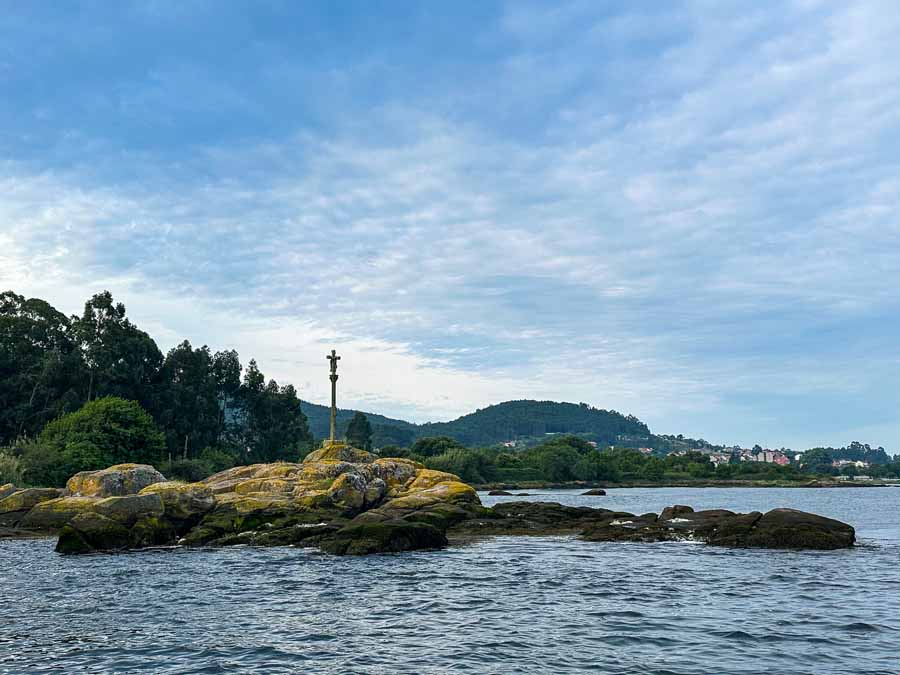
The boat exits the large open bay to head to the Ulla River. This is when you can start observing the stone cruceiros along the waterway. There are 17 stone crosses in total on the Way of the Cross.
Further up the way will be the remains of the Oeste Towers with a small chapel built into the front. The castle was said to be built around the 9th century to protect the area from Viking invasions.
The Maritime Way of the Cross is the spectacular ending to the Variante Espiritual.
The boats will tie up close to the village of Pontecesures, which is where the Camino Espiritual rejoins the Camino Portuguese. Pontecesures is one of the only sections of the Spiritual Variant that has a large industrial zone.
The embankment dock in Pontecesures is a little over a mile before the historically important city of Padrón.

Day 3 | Vilanova de Arousa – Padron By Walking
- 18.6 Miles / 30 KM | + / – 9 Hours
Most pilgrims opt to take the boat ride for the final day of the Variante Espiritual route. I have yet to meet a pilgrim who has chosen to walk the final day of the Variante Espiritual Camino route.
Not only is the distance long, but there is a large hill, making the trail quite tough and challenging. While the official markers say the final day is 30 KM, with the added ascent, it is closer to 36 KM. This makes for a long and challenging day.
In addition, the lodging options are not cheap. However, the Xunta has started to add Albergues from Vilanova de Arousa until just before Padron. There is a new Municipal Albergue in Carril, with the next being located in Pontecesures (where the boat docks).
My Personal Budget for Camino Espiritual
So, how much did the Variante Espiritual route cost me? This Camino route took me 3 days. It’s worth noting that I didn’t prepare any meals and ate mostly pilgrim meals. I purchased a limited number of items from the grocery store.
I drank coffee every morning and slept in my first private room ever on any Camino de Santiago route!
| Expenses | Euro (€) |
| Accommodation (Private Room & Municipal Albergue) | €45 |
| Meals & Snacks & Cafes | €47 |
| Groceries | €9 |
| Donation | €1 |
| Boat Fare from Vilanova de Arousa to Pontecesures | €30 |
| Total | €132 |
The Camino Espiritual cost me around €132. I could have saved money by cooking my own meals and by sleeping at the Albergues, but they were booked due to the large group.
I didn’t include the night I slept in Teo, but it was at a Municipal Albergue. The Variante Espiritual Camino cost me just a little more than my standard 30 – 40 Euro daily budget.
Be mindful that prices have increased in Spain in general, including pilgrim meals, the boat ride, and cafe stops.
What Next After the Variante Espiritual?

If you opted for the boat ride, chances are that you’ll arrive early in the historical city of Padrón. Padrón is only a day’s walk from Santiago de Compostela, and since this is believed to be where the stone boat was moored with Saint James’ body, there is a lot to see here.
Some pilgrims may opt to sleep in Padron. There are plenty of albergues to choose from, and there is a Municipal Alberge in Padron.
Municipal Albergue Padron | Find it here: Rúa Costiña do Carme | Pilgrim Beds: 48 / €10 |Open: Year round with the doors opening at 13:00 and closing at 22:00 | Credencial Required & No Reservations Accepted
More Padron Albergues
- Albergue Corredoiras
- Albergue Camiño Do Sar
- Albergue & Rooms Murgadán
- Browse all the Padrón Accommodation Options
Padrón Certificate
Padrón has begun its own city certificate called the Pedronía. Certificates like this are what you can obtain from walking the Camino Finisterre Muxia or the Camino de San Salvador.
The Pedronía has its own Credencial booklet, but it’s possible to use your official Credencial for the Camino Portugues.
The Credencial can be printed here or obtained from the Padrón Tourist Information Center. To qualify, you must walk to Padron via the Camino Portuguese or take the boat from Vilanova de Arousa. Sites to visit include:
The Pedrón stone is found inside the Church of Santiago de Padrón, and the Church of Santa María of Iria Flavia, one of the oldest churches in Galicia. The Church of Santa Maria of Iria Flavia is a little outside of Padron.
It’s also suggested to visit the sites of the Fonte do Carme and Santiaguiño do Monte, which are linked to the Translatio of Saint James.
Once you receive all the stamps, take the credential to the Municipal Albergue in Padron to receive the Pedronia certificate.
Continuing Along the Camino Portuguese

For me, I continued to Teo to cut my distance to Santiago de Compostela. I also wanted to stay in Teo to visit the rumored site of Queen Lupa’s Castro. While there is not much remaining of the fortress, there is an old wall with incredible views of the area.
My time in Peru visiting Inca sites has drawn me to ruins and sacred sites.
Queen Lupa comes up again and again in the story of St. James and the burial of his body. Little is known about her, except that she was a Pagan Queen who ruled over Galicia and was said to surround herself with wolves, bears, and wild animals.
Some wonder if she was real, or a fabled character to help with the conversion of Christianity in this very Pagan region. Her legend stretches across the way to Pico Sacro on the Camino de Invierno and up to the Death Coast to Monte Pindo near Cee Spain.
She often plays the role of the villain; however, many strong and independent women are written into these roles in the Bible.
Either way, I think the route up to Queen Lupa’s old fortress is worth the detour.
The Ultimate Camino Variante Espiritual Guide & Why It’s Worth Walking
In short, this is my ultimate guide to the Variante Espiritual Camino of the Portuguese way. This detailed guide includes frequently asked questions, stages of the Spiritual route, my personal route, details on the boat ride, and a typical budget.
My three-day route includes two days of walking from Pontevedra to Vilanova de Arousa. The final day is usually done via boat along La Traslatio. The maritime route is said to follow how the Apostle James’ body reached Spain from Jerusalem.
The stunning route highlights charming villages, monasteries, lovely forest paths, and a memorable boat ride via the Way of the Cross. The Variante Espiritual route is definitely worth the detour!
Have you walked the Camino Espiritual along the Portuguese Way? Are there any updates I need to add about the Variante Espiritual? Let me know in the comments below!
Pack This Post for Later! Pin It!


Disclaimer: There’s a chance this post contains affiliate links, and I receive a small (but grateful) portion of the sale. There’s no extra cost to you, and I only promote things that I use and love.


Hi! Thank you for such a detailed account of your experience! My friends and I are walking the Camino Espiritual as part of our last 100 trip this July. I’m wondering – did you ever stop to swim along the route? Do pilgrims often do that? I love swimming and I’m wondering if the routes often take you right alongside the shoreline. Thank you!
Hey Katie-
I walked in June and did get to enjoy some beaches! While I walked inland, I moved to the Espiritual route from Pontevedra.
In Combarro, the tide was really far out in the estuary, so people were out harvesting shellfish and the beaches were not a good option. Of course, this will change on the tide and if you opt to sleep there. If you love a small seaside village, Combarro is a great choice.
On the final day, I arrived in Vilanova de Arousa quite early so dropped my things off at the Albergue and spent my afternoon lounging on the beach across the bridge in the village of Terrón. It was fabulous.
There were lots of rivers and streams and some days I let my feet soak in the water.
The best thing about the Camino is it’s yours! If you have time afterward, walking to Finisterre and Muxia is really special, too. I loved ending my Camino at the sea because it was so symbolic.
Buen Camino! 💙💛