

Visit Las Médulas One of the Most Unique Places to See in Spain
One of the more unique places to visit in Spain lies tucked away in the far corners of the El Bierzo region, the ancient Roman ruins of Las Médulas. The bright red faces of the mountainside are iconic, but they are the remnants of what is left behind of one the most important Roman gold mines.
Gold was first extracted here during the 1st century and continued for two centuries using advanced hydraulic channels built into mountainsides.
Las Médulas is a short day trip away from Ponferrada, a historical city tied to the Knight’s Templar and the Camino de Santiago. While there are day trips and the site can be easily explored with a car, those walking the Camino de Invierno route will actually walk right past this important site.
Today, as a UNESCO World Heritage Site, Las Médulas offers hiking trails, guided tours, and numerous viewpoints that showcase one of the greatest and well-preserved Roman mines in history.
Here’s how to make the most of a visit to Las Médulas.
Table of Contents
- Why is Las Médulas Significant?
- How to Visit Las Médulas
- Places to See in Las Médulas
- Las Médulas Village & Places to See Nearby
- Conclusion | A Quick Guide to Las Médulas the Old Roman Gold Mines
Why is Las Médulas Significant?

Las Médulas was one of the most significant gold mines for the Roman empire. The gold was extracted by an ancient gold mining technique called ruina montium, which literally translates to ruin mountain. The process was described by Pliny the Elder in his book “Historia Naturalis.”
The land was inhabited by numerous pre-Roman civilizations whose settlements can be seen in nearby castros. Upon Roman occupation, these people were forced to work a certain number of days per year in the mines. While the Romans state that these were free people, they were indebted to the Roman crown and were forced to work off their taxation fees. Many died and suffered due to the Roman’s infatuation with Gold and the coin.
Over 600 Km (373 miles) of water canals were carved into the surrounding Aquilianos Mountains. In fact, I followed old Roman canals while hiking near the magic pueblo of Peñalba de Santiago, nearly 20 miles away.
Water was collected from springs, snow, and bodies of water which was stored in the reservoirs. The Romans used an advanced hydraulic system with dams that would blast away the mountainside. As the mountain crumbled, debris would run through washing channels, with the heavier gold pieces sinking to the bottom of the channels.
The mines were used during the first century and finally abandoned in the early 3rd century. During the two centuries, Las Médulas was in operation, nearly 1,635,000 kilos of gold were extracted throughout the life of the mines.

The landscape was forever altered. Many deposits of the large stones (murías) were moved and some formed natural dams to create lakes. This can be seen in the nearby Carucedo Lake. The murías helped create the surrounding wetland area, which has a more humid climate than the surrounding area. The devastated landscape is now home to agricultural fields.
In 1997, Las Médulas was recognized as a UNESCO World Heritage Site as a Cultural Landscape. There was some pushback from some countries, especially Thailand since the area had been formed due to human destruction. It’s also been found that lead pollution peaked during the Roman Empire and was tied to the extraction of gold.
With the contrast and duality of destruction and the beauty that remains, Las Médulas is worth visiting. It is also a very little-known and visited site in Spain.
How to Visit Las Médulas from Ponferrada

Las Médulas is a short distance from Ponferrada, a medieval city that is the capital of the El Bierzo region. This interesting city is found in the far west corner of the autonomous region of Castile and León and sits close to the border of the incredible region of Galicia.
It’s worth noting the Las Médulas translates to the Marrows, although some wonder if the names were lost somewhere in translation.
Ponferrada has deep connections to the Camino de Santiago. The Camino Frances passes through the city, making Las Médulas a worthwhile day trip from the city on a rest day.
The easiest way to get to these old gold mines is by renting a car, as part of an organized tour, or by walking the Camino de Invierno. There are very limited public transportation options to Las Médulas, especially in the offseason.
Visit Las Médulas with a Car

Las Médulas is around a 30-minute drive from Ponferrada. There is a large free parking lot on the outskirts of the town. Find it here.
Be mindful that on weekends and holidays, Las Médulas is busy with domestic tourists, so it’s best to avoid weekends and arrive early.
Visit Las Médulas on a Tour
Las Médulas is still an up-and-coming destination in Spain. There are a few limited tour services from Ponferrada. Check in with the Tourist Information Center in Ponferrada to help assist with guided tours. There is also this full-day tour from Ponferrada, but it comes with mixed reviews.
As this UNESCO site raises in popularity, expect to find more guided tour options.
The site is easy to navigate upon arrival with numerous information boards and labeled hiking routes. A tour is not really necessary, especially since guided tours are run through the Information Center.
Walk to Las Médulas on the Camino de Invierno

Ponferrada is the city where it’s possible to take the divergent route off of the Camino Frances and onto the Camino de Invierno. This alternative path is known as the Winter Way and was used by medieval pilgrims to avoid the high mountains on the French Way near O’Cebreiro of Galicia.
Las Médulas is just over 28 Km (17.4 miles) from Ponferrada on the Camino de Invierno. Typically, this is the first stage of the Camino de Invierno. However, it’s a long first day of walking for pilgrims, so most opt to sleep in Villavieja to break up the rather long stage.
Most pilgrims will follow the marked route from Villavieja to Borrones village, and onto Carucedo before arriving at Las Médulas. Alternatively, in Borrones, it’s possible to take the scenic path to Orellán and catch those first stunning views of Las Médulas from the Mirador de Orellán.
The Camino de Invierno is one of the most underrated Camino de Santiago routes and passes by the impressive Roman gold mines, small mountains hamlets, historical cities, and twists through stunning river valleys and overlooked wine regions.
If walking any Camino de Santiago route, it’s best to pack only what you need, listen to your body, and enjoy the journey. These are some of my best Camino de Santiago tips for first-time pilgrims.
Places to See in Las Médulas
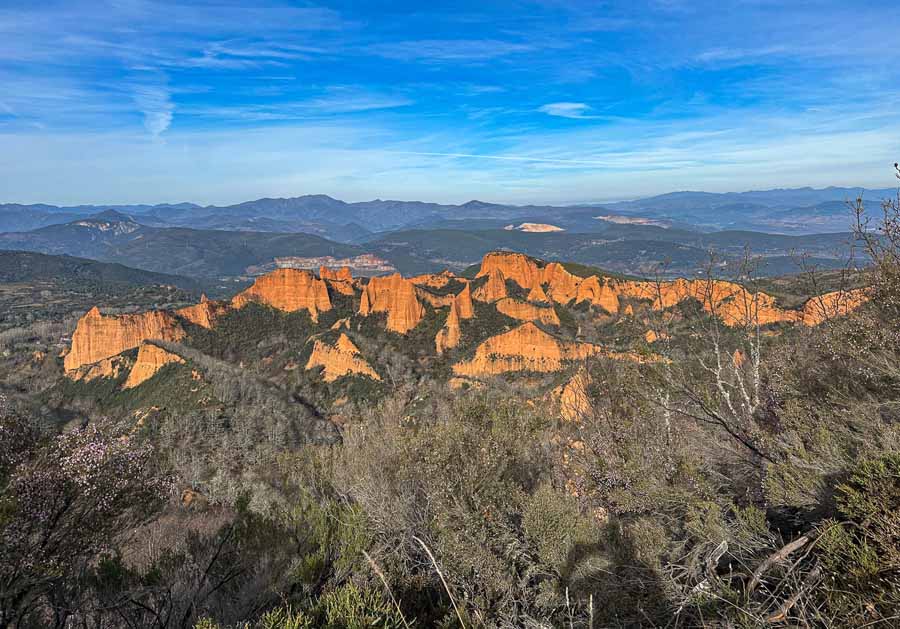
Las Médulas offers many places to visit and highlights include touring the old gold mines to hiking between the numerous viewpoints.
It is free to visit Las Médulas except there are two attractions that require a small admission fee.
- Guided Tours of the Cave System that are organized at the Visitor Reception Center €5
- Galerías de Orellán €3
Las Médulas Visitor Reception Center
The first place to start is at the Las Médulas Visitor Reception Center. This information center has tons of resources including hiking and regional maps and an interesting video explaining the ruina montium mining method. This is also where you inquire and join the guided tours that run through the extensive cave systems.
The only way to visit the interior of mines is as part of a guided tour.
Guided Tours for Las Médulas | Inquire here: Las Médulas Visitor Reception Center | Duration: 2 hours | Admission: €5 | Schedules change by season, but typically morning and afternoon start times / Contact: medulas@ccbierzo.com
Wander Through Las Médulas


Even if you can’t visit the interior of the caves, do spend some time wandering through the heart of this historical site. Oftentimes some of the cave paths along the main hiking trail can be closed due to landslide risks. However, it’s still worth walking through the site, even if the caves are temporarily closed.
For me, while beautiful, this site stirred up quite a bit of emotion. The exposed orange mountainsides are only visible today due to humans interfering with the land to extract precious metals. Many suffered and lost their lives in the name of gold and the greed of the Roman Empire.
The paths are lined with ancient chestnut trees. Again, these were brought during the Roman occupation as they were one of the few trees that could survive on the land. The chestnuts also provided a food source to those forced to work in the mines.
It’s hard not to let your mind wander to what this site looked like nearly 2,000 years ago.
There are two main hiking trails, Las Valiñas and the Perimeter Path.

Those looking for an interesting hike through the heart of it all can take the trail of Las Valiñas. This route starts from the Aula Arqueológica Museum, passes through town, and does a small loop through the site. This route is fairly easy at around 3.5 km (2.2 miles) and takes about an hour to complete.
This trail through Las Médulas can easily be picked up across from the Complejo Rural Agoga, a popular place to sleep with a restaurant.
Alternatively, the most extensive hiking route is the Perimeter Route. This route passes by a majority of the highlights of Las Médulas and takes at least 4 hours to complete. The loop trail is around 14.5 Km (9 miles) and merges with sections of the Las Valiñas route. Be mindful that there is an optional ridge section that is not recommended for those not equipped with good hiking shoes or experienced on narrow trails.
This is a great hiking guide and map if looking to take the perimeter route and see some of the other nearby highlights and lakes.
Mirador de Orellán & Galerías de Orellán


By far one of the best views of Las Médulas comes from the Mirador de Orellán. This observation deck provides plenty of signboards with panoramic views to better understand the mining techniques.
The Galerías de Orellán is steps away from the observation deck and offers a chance to walk through the old quarry channel through one of the mountainsides. It’s a short walk through the old water channel that opens to views of the site. Be mindful that this is a paid site and you must wear a hard hat to enter. This water channel shows the effects that blasting the mountainside had on the landscape.
I’m totally bummed I missed walking through the Galerías de Orellán, as I couldn’t find much information on them before my visit!
Find it here: Orellán Galleries | Duration: 30 minutes | Admission: € 3 and must be paid in cash | Schedules change by season, but typically morning and afternoon entrances 11:00 – 13:30 / 16:00 – 17:30, closed Tuesdays
Mirador de las Pedrices


Another fantastic viewpoint outside of Las Médulas village is the Mirador de las Pedrices. This viewpoint highlights the red devastated mountain faces with views of the village. There are also lots of informational signboards explaining the distant lakes and their effect on the landscape.
For me, the panoramic views were great. You can also look in the opposite direction towards the Valley of Yeres and see remnants of the old channels left behind.
Chao de Maseiros Observation Deck
With more time or on a longer hiking route, take the hike out to Chao de Maseiros. This observation deck is past Lake Somido and offers a chance to see the effects of the waste drainage field.
It also passes by the few small lakes near Las Médulas.
Las Médulas Village & Places to See Nearby

Las Médulas offers lots of things to see and do. It is easy to spend the entire day exploring the hiking trails and taking a guided tour of the caves.
Las Médulas has plenty of cafes and restaurants serving up typical cuisine. The region of El Bierzo is famous for its delicious wine with the most famous grape varietals being Mencia (red) and Godello (white).
It’s worth noting that I tried to visit the Aula Arqueológica de las Médulas (Museum), but it is currently permanently closed and the visitor center was unsure if the museum would ever open again. This was a major bummer as it is said to house some interesting artifacts found within the vicinity of Las Médulas.
Places to See Nearby


✔ Cornatel Castle is a short drive away and has ties to the Order of the Knight’s Templar. If walking the Camino de Invierno, the way passes right by this historic hilltop castle.
✔ Puente de Domingo Florez is a fantastic village that sits right on the border of Galicia. The village is connected to Las Médulas via a scenic path that is part of the Camino de Invierno. Pilgrims will love the fantastic donativo albergue Casa Rosa, run by a sweet family who has walked numerous Camino routes.
✔ Carucedo village famous for its Carucedo Lake was formed due to the mining activity of the Romans and from the melting of ancient glaciers of the area.
✔ Less than 30 minutes away is the impressive hilltop village of Villafranca del Bierzo. This town is a popular town on the Camino Frances. It is known for its Church of Santiago with its Puerta del Perdón. This significant church on the Camino could issue the Compostela for those medieval pilgrims who were too sick or tired to reach Santiago de Compostela.
Where to Sleep in Las Médulas

With so much to see, many visitors opt to spend at least one night in Las Médulas exploring the UNESCO World Heritage Site and nearby points of interest. Alternatively, it’s also convenient to visit Las Médulas as a day trip from Ponferrada and sleep there instead.
Be mindful that this is a popular summer tourist destination for domestic tourists (Spanish) and that oftentimes the peak summer season and weekends some places may require a two-night stay.
- Albergue La Senda is a budget-friendly accommodation option for those looking to explore Las Médulas, especially those walking the Camino de Invierno.
- Casa Socorro is a local pension located in the heart of Las Médulas village
- Lares · Cabañas Rurales offers private vacation houses with a kitchen, living space, and private bathrooms. These are highly rated places to stay in Las Médulas
- Hotel Medulio is a standard hotel found within the village and close to the free parking lot
- Agoga Rural Complex of Las Médulas is steps away from the old gold mines and has a big green space, high reviews, and offers a connected restaurant
➜ Browse all the Best Places to Stay in Las Médulas Leon
⁉️ Psst… Hey pilgrims, I think it’s best to sleep in Villavija and Puente de Domingo Flórez to avoid the more expensive accommodation options in Las Médulas.
Conclusion | A Quick Overview of Las Médulas
In short, this is a quick guide on how to visit Las Médulas, the once most significant gold mine of the Roman Empire. This old way of mining gold utilized hydraulic power that required extensive water canals built into the mountainsides. The water would blast out of the mountain and the gold was extracted.
This unusual Roman ruin is found not far from Ponferrada, a medieval city in León that sits close to the border of Galicia. It is found along the Winter Way Camino route.
Today, Las Médulas is recognized as a Cultural UNESCO World Heritage Site and offers a plethora of hiking trails, viewpoints, and chances to visit what remains of the cave system.
This quick guide showcases how to get here, the best things to see at Las Médulas, tips for visiting, and points of interest to see nearby.
Las Médulas is definitely one of the more interesting and underrated places to see in Spain. Although popular with domestic tourists, few international tourists make the effort to visit this historical site. With few tourists, stunning landscapes, and a complicated history, Las Médulas is worth visiting.
Have you been to Las Médulas? What did you think of this UNESCO World Heritage Site in Spain? Are there any updates or corrections on this site? Let me know in the comments below!
Pack This Post for Later! Pin It!

Disclaimer: There’s a chance this post contains affiliate links, and I receive a small (but grateful) portion of the sale. There’s no extra cost to you, and I only promote things that I use and love.


