

The 7 Main Historical Cities on the Camino Frances (And Why They Make Great Rest Days)
The Camino de Santiago is the most famous pilgrimage route in Europe. There are many routes to choose from, with the most popular routes twisting through France, Portugal, and Spain. Hundreds of thousands of pilgrims complete the journey each year, standing in front of the impressive Cathedral of Santiago de Compostela, the alleged burial place of Saint James.
The most popular Camino route is the Camino Frances or the French Way of Saint James. The French Way has been walked for centuries by Christians, and thousands of years before that, Celtic tribes, following the Milky Way all the way to the sea.
Along the Camino Frances are major historical cities. The largest cities along the route of the Camino Frances are Pamplona, Burgos, León, Astorga, and Ponferrada. Of course, the route ends at Santiago de Compostela, which is the most significant for those pilgrims walking the Camino de Santiago.
This overview includes a look at the six major cities on the Camino Frances and things to do in each one. With so much history and sites, many pilgrims decide to take rest days in these cities. From delving into the local cuisine, visiting stunning cathedrals, and exploring the museums, each of these cities has something different and unique to offer.
At the end, I’ve also included the best things to do in Santiago de Compostela.
Here is an overview of the largest historical cities found along the Camino Frances.
Table of Contents
Disclaimer: There’s a chance this post contains affiliate links, and I receive a small (but grateful) portion of the sale. There’s no extra cost to you, and I only promote things that I use and love.
- Overview of the Camino Frances
- The Biggest Cities on the Camino Frances
- Pamplona
- Logroño
- Burgos
- León
- Astorga
- Ponferrada
- The End of the Camino de Santiago | Santiago de Compostela
- Conclusion | Historical Cities on the Camino Frances
Overview of the Camino Frances
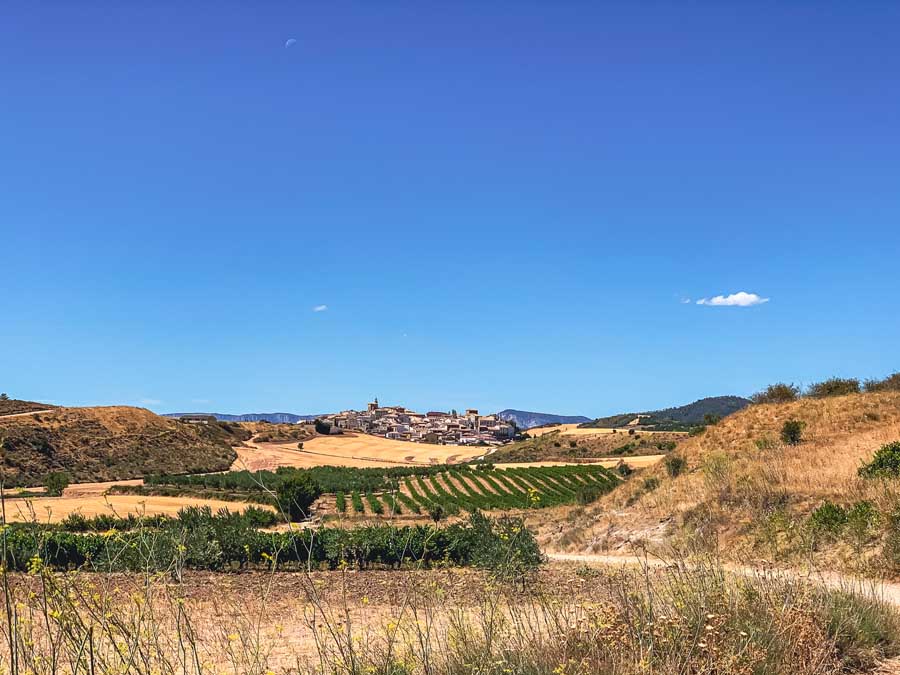
The French Way is the most popular Camino de Santiago route. The “official” starting point of the Camino Frances is Saint-Jean-Pied-de-Port in France. However, pilgrims can choose whatever starting point they feel called to. It’s essential to walk 100 Km on the route to receive a Compostela, or a completion certificate.
The Camino Frances starts with crossing the stunning Pyrenees Mountains, moves through the vineyards of the La Rioja wine region, and onto the historical city of Burgos, where pilgrims will walk their first steps into the Meseta.
The Meseta is an open plateau with only small villages and the vastness of fields and openness. Pilgrims either love or hate the Meseta; for me, it was the most profound part of my journey, a place that gave me time to reflect in solitude.
The Mesta continues to León, and then the route moves into a paramo landscape until just before it reaches Astorga. Astorga is one of the smallest historical cities on the Camino Frances.

From Astorga, pilgrims will cross the Montes de León and reach Ponferrada, a city known for its connections to the Knights Templar. After that, the route continues to the Bierzo region, which leads pilgrims into the magic of the Galicia region, an autonomous region known for its own language, culture, and Celtic roots.
Pilgrims arrive at the Praza do Obradoiro to gaze at the impressive Cathedral of Santiago de Compostela.
More About the Camino de Santiago
In the first steps of planning the journey? My best advice is to pack light, follow the yellow arrows, and let the magic unfold.
After walking 12 Camino de Santiago routes, these are my best tips for first-time pilgrims.


➯ Hey… don’t forget your Travel Insurance! I love SafetyWing
The Biggest Cities on the Camino Frances
Here is an overview of the main historical cities on the Camino Frances. I’ve listed these cities from east to west, as that’s the direction most pilgrims will be walking.
Remember, many of these cities are popular rest days for pilgrims. Many pilgrims utilize sleeping in Albergues, or budget-friendly accommodation options for pilgrims.
Municipal Albergues do not allow reservations and only allow to sleep there one night. If planning on taking a rest day in one of the following cities, it’s best to stay at a private albergue, hotel, pension, or alternative accommodation options.
Here are the 6 largest cites on the Camino Frances.
1 | Pamplona | Navarre Region

- Population: 208,243
- Typical Walking Stage: +/- 3 Days from Saint-Jean-Pied de Port
- Distance to Santiago de Compostela: 731.5 KM (454.5 Miles)
- Why It’s Significant on the Camino Frances: It’s the first major city after crossing the Pyrenees Mountains
Pamplona is a fantastic hilltop city that is part of the Greater Basque cultural region. Although it’s technically not located in the autonomous Basque Country, it still has ties to the Basque language, culture, and cuisine. You may notice signboards stating Iruña, which is actually Pamplona in the Basque language.
Pamplona is the first major city pilgrims will arrive in after crossing the Pyrenees Mountains. The city has deep connections with the pilgrimage route of the Camino de Santiago and has beautifully preserved city walls. Pilgrims enter the city gates at Portal de Francia, which has been welcoming pilgrims since the medieval ages.
Pamplona has the Gothic 15th-century Cathedral of Santa María la Real. The Cathedral is also known for its beautiful cloister and the museum. The Museo de Navarre is also worth a visit, especially since it is in an ancient pilgrim hospital.
Pamplona is most famous for its annual San Fermin festival, more commonly known as the running of the bulls. This festival takes place every year from July 6th to July 14th.
Ernest Hemingway was also drawn to the city, and there are many statues of him found around town. He can be spotted outside the Plaza de Torros (bull ring) and at his favorite cafe, Cafe Iruña. This cafe is located in the bustling living room of the city, the Plaza del Castillo.

One of the best things to do in Pamplona is simply wander the streets and stop in at local pintxos bars and sample the cuisine. We loved Calle Mercaderes and Calle San Nicolás for nibbling on pintxos. Of course, walking through Plaza del Castillo provides numerous places to stop for a drink or snack, and the area around Fuente de la Navarrería.
Along the Old Town of Pamplona, there are a few places to see the Old City Walls. Those who want to walk outside of old town can spend time in the Jardines de la Taconera. Across the street is Parque de La Vuelta del Castillo, with it’s 16th century Citael Fortress.
Popular Places to Sleep in Pamplona for Pilgrims
- Municipal Albergue / Jesús y María / 112 Beds/ NO reservations during high season / 11 €
- Albergue Diocesano Betania / 20 Beds / NO RESERVATIONS / Donativo
- Hostel Casa Ibarrola
- Aloha Hostel
- Iraipe Pamplona Hostal
- Hostal Espoz y Mina
Highly-Rated Pamplona Hotels
- Pamplona Catedral Hotel
- Eurostars Pamplona
- Hotel Maisonnave
- Hotel Ciudadela Pamplona
- Hotel Tres Reyes Pamplona
➜ Browse all the Best Places to Stay in Pamplona
2 | Logroño | La Rioja Region

- Population: 152,107
- Typical Walking Stage: +/- 7 Days from Saint-Jean-Pied de Port
- Distance to Santiago de Compostela: 615.5 KM (382.5 miles)
- Why It’s Significant on the Camino Frances: It’s the heart of the La Rioja Wine Region, and the nobility of Spain has been promoting the route since the 11th century to help export the wine and import artists and stone masons.
Logroño is the capital of the La Rioja region and the most populous city in the autonomous community of the same name. Logroño welcomes pilgrims into the city with a giant footbath and then by crossing the Ebro River via the Puente de Piedra.
Logroño has always been an important stop for pilgrims walking the Camino de Santiago French Way, so many a majority of the historical sites include churches and religious sites. The Cathedral of Santa María de la Redonda was built between the 15th and 18th centuries. However, there are numerous churches scattered throughout the city.
The Old Town in Logroño is charming, has a lovely market, a fantastic free museum (Museo de la Rioja), and bodegas that are found right in the city limits. There are so many things to see and do in Logroño.

Logroño’s culinary treasures are found on Calle Laurel. This street is home to around 60 different tapas and pintxos bars that all offer local wines of the La Rioja wine region. At night, the streets come alive with musicians and hungry visitors and locals alike soaking in the jovial ambiance. With so many different tapas bars, it’s easy to see why pilgrims take a rest day in Logroño.
Logroño is a short distance from Clavijo. This small pueblo is famous for the mythical battle of Clavijo that happened in 844 between the Christians and the Moors. With an extra rest day, it would be easy to rent a car or hire a taxi and visit for a few hours.

The legend of the Battle of Clavijo says that while the Christians were losing the battle, St James miraculously appeared, leading them to victory. His intervention became a symbol of divine protection along the Camino. However, there is actually no proof of the battle; it’s more the story that birthed the “reconquista.”
In Clavijo, there is a spectacular hilltop castle. For me, I hiked to the ruins of San Prudencio Monastery, which are special but may not be to everyone’s taste.
Popular Places for Pilgrims to Sleep in Logroño
- Albergue de Peregrinos de Logroño / 68 Beds/ NO RESERVATIONS / 10 €
- Albergue Parroquial Santiago el Real / 30 Beds / NO RESERVATIONS / Donativo
- Albergue San Nicolás
- Winederful Hostel & Café
- Hostal La Numantina
- El Patio de San Nicolas
Top-Rated Private Rooms in Logroño
- Pensión La Castellana
- EightRooms La Rioja Pension
- Hotel Condes de Haro
- Hotel Sercotel Portales
- Apartamentos Laurel
- Eurostars Marqués de Vallejo
➜ Discover the best places to stay in Logroño Spain
3 | Burgos | Castile & León Region

- Population: 178,966
- Typical Walking Stage: +/- 12 Days from Saint-Jean-Pied de Port
- Distance to Santiago de Compostela: 493 KM (306 miles)
- Why It’s Significant on the Camino Frances: It’s home to the UNESCO-Listed Catedral of Santa María de Burgos, a Gothic Cathedral where legendary Knight El Cid and his wife are buried. This is also the last major city before pilgrims depart for their journey on the Meseta.
Burgos is known as being the “Gothic Capital of Spain.” In fact, the stunning Cathedral of Burgos is one of the most significant Gothic cathedrals along the Camino de Santiago.
The cathedral was built over 300 years, with construction beginning in 1221. Today, the Burgos Cathedral boasts impressive art collections, particularly those in the Gothic style, including stained glass windows, chapels, and the tombs of El Cid and his wife. The famous warrior is a national hero in Spain and is the main character of the epic poem “Cantar de mío Cid.”
Most pilgrims will be walking for around 2 weeks by the time they reach Burgos, so it makes an ideal place to take a rest day. Burgos is the final city before pilgrims embark on the journey across the vastness of the Meseta, where they will encounter only small villages. This is a good place to restock supplies, do laundry, and slow down.
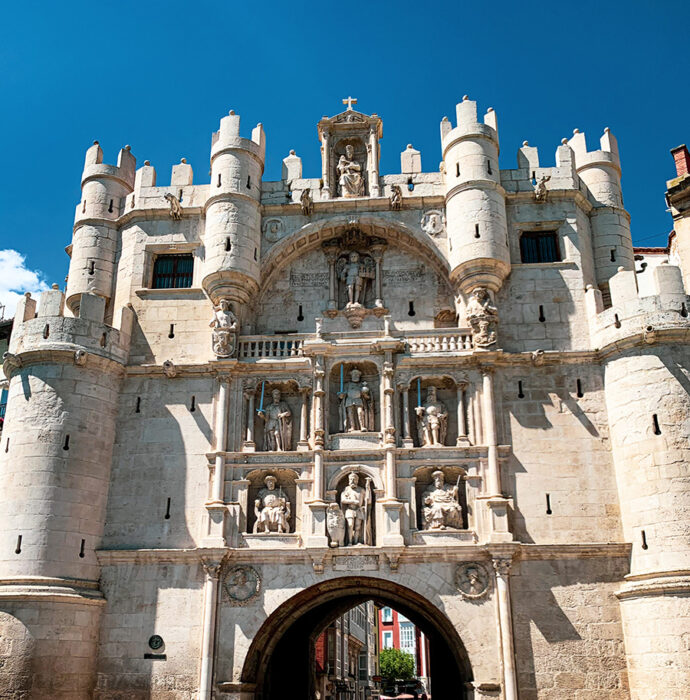
Besides the main Cathedral in Burgos, the Arco de Santa María is a lovely medieval gateway to the city. I enjoyed journaling and walking along the Paseo del Espolón, the park right outside the gate. There are plenty of places to relax, grab a drink, or stroll along the Arlanzón.
One of the best views of the city is from Mirador Del Castillo. The Castle itself is small but worth a quick visit; however, it’s currently closed for renovations.
Popular Places for Pilgrims to Sleep in Burgos
- Albergue de Peregrinos de Burgos / 120 Beds/ NO RESERVATIONS / 10 €
- Albergue Santiago y Santa Catalina “La Divina Pastora” / 16 Beds / NO RESERVATIONS / 11 €
- Hostel Catedral Burgos
- Mola! Hostel Burgos
- Hostel Trovadores
More Places to Stay in Burgos
- Crisol Mesón del Cid
- Abba Burgos Hotel
- Hotel Alda Entrearcos
- Hostal riMboMbin
- NH Collection Palacio de Burgos
➜ Browse all the Best Places to Sleep in Burgos
4 | León | Castile & León

- Population: 122,866
- Typical Walking Stage: +/- 3 Weeks from Saint-Jean-Pied de Port
- Distance to Santiago de Compostela: 309 KM (192 miles)
- Why It’s Significant on the Camino Frances: León was an important Roman city and became a significant hub for pilgrims walking the French Way since the Middle Ages.
León is a fabulous historical city on the Camino Frances. For me, I’ve visited numerous times, and each time I visit, I find something new and exciting about the city. As a pilgrim, the three most important buildings in León connected to the Camino de Santiago are the León Cathedral, the San Marcos Convent, and the Basilica of San Isidoro.
By far one of the most memorable cathedrals on the Camino Frances is the Pulchara Leonina in the heart of the Old Town. The stunning León Cathedral boasts 125 beautiful stained glass windows that show the story of saints and stories of the New Testament in the Bible.
Don’t miss the Basílica de San Isidoro, which also complements the León Cathedral. The Museum of San Isidoro is worth visiting and houses numerous relics and jewels. By far the most incredible thing to see is the Pantheón Real, an ancient chapel that was built during the 11th century. On the ceiling, find original and beautiful frescos that are nicknamed the “Romanesque Sistine Chapel” of Spain.

The San Marcos Convent started as a pilgrim hospital in the 12th century. Later, the building became the headquarters of the Order of Santiago. The Plaza of San Marcos has a pilgrim statue that appears fatigued while resting in front of the now impressive building. To the left of the Convent is the luxurious Parador Hotel of León.
Besides the three main historical buildins in León, there are numerous attractions. León has one of the best tapas scenes in Spain and it’s easy to get lost and a little tipsy trying all the culiary delights in the Barrio Húmedo.

There’s a fabulous Gaudí building, Casa Botines, which can be visited.
León is an ideal place to take a rest day. There really is so much to see and do and it’s one of my personal favorite cities on the Camino Frances.
León is a welcome escape for pilgrims walking the final stages of the Meseta. While the Meseta technically continues before Astorga, León offers a great alternative route on the Camino Frances via the paramo landscape. I took this route and loved sleeping in Oncina de la Valdoncina at the Albergue El Pajar de Oncina, one of my favorite albergues on the French Way.

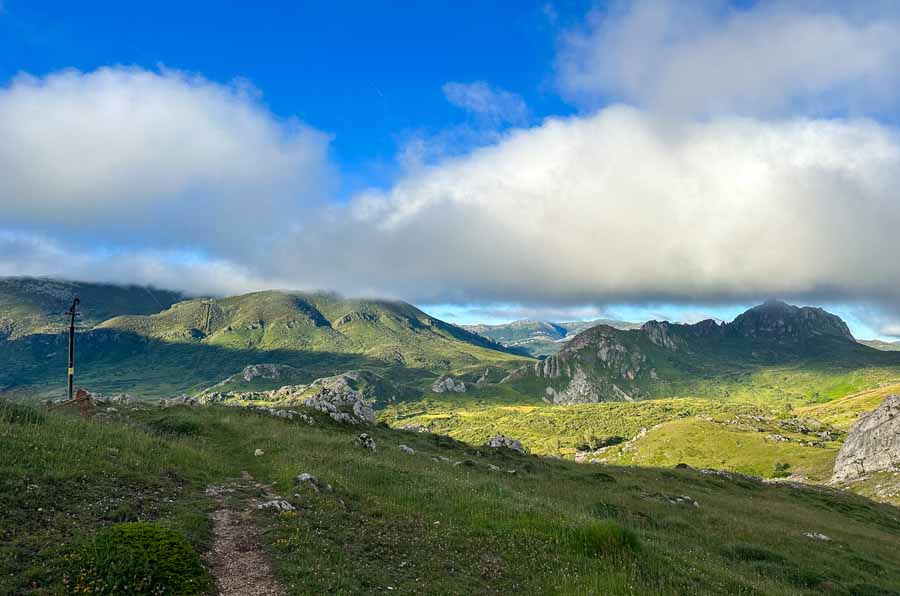
León also offers a fantastic divergent route off the Camino Frances. Pilgrims can walk through the mountains taking the Camino de San Salvador. This route takes pilgrims from the Camino Frances to Oviedo, where they can walk the Camino Primitivo into Santiago de Compostela.
Popular Places for Pilgrims to Sleep in León
- Albergue de las Carbajalas / 85 Beds/ NO RESERVATIONS / Donativo
- Albergue de Peregrinos Residencia San Francisco de Asís / 92 Beds / 12-18 €
- Check In León
- Hostel Covent Garden
- Hostel Quartier Leon Jabalquinto
- Palacio Real Hostel
More Places to Stay in León
- Suites La Catedral
- Hospedería Pax
- Hotel Rincón del Conde
- Hotel Alda Vía León
- SUITES BERRUETA
- Hotel Real Colegiata San Isidoro
➜ Browse all the Best Places to Sleep in León
5 | Astorga | Castile & León

- Population: 12,078
- Typical Walking Stage: +/- 22 Days from Saint-Jean-Pied de Port
- Distance to Santiago de Compostela: 262.5 KM (163 miles)
- Why It’s Significant on the Camino Frances: Astorga was an important Roman City and during the Middle Ages, it offered over 20 pilgrim hospitals for those pilgrims walking the Camino Frances and those pilgrims coming from the south on the Via de la Plata.
Astorga is one of the smallest cities on the Camino Frances, with just over 12,000 inhabitants. It is a major hub for pilgrims as the Camino Frances passes through it, and pilgrims who started in the south of Spain will reach Astorga from the Via de la Plata route.
Astorga has the Cathedral of Santa Maria. This Cathedral was built between the 15th and 18th centuries in mostly a Gothic architectural style. The Cathedral admission also includes a visit to the connected museum.
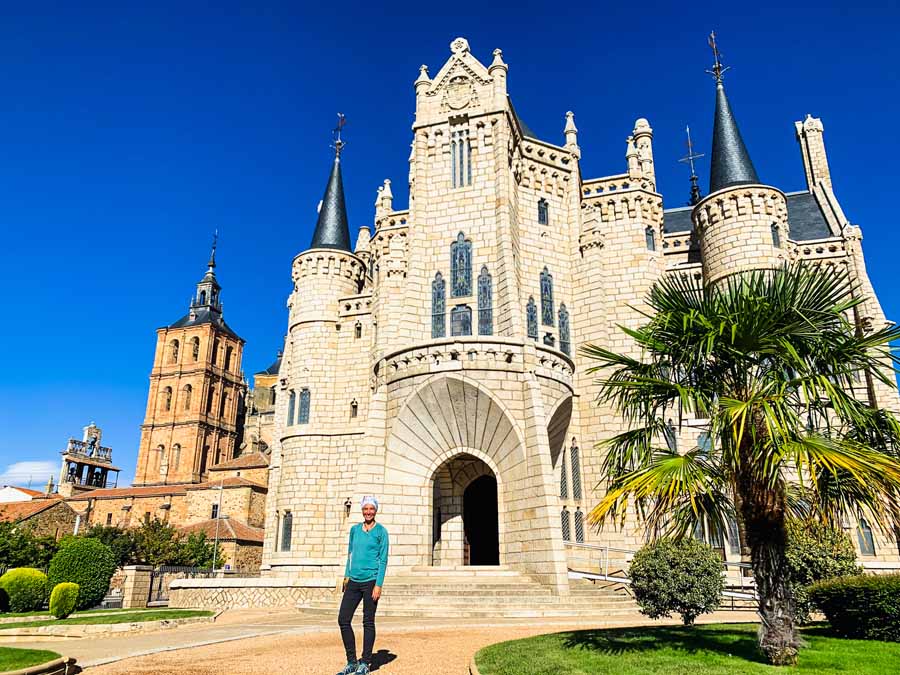
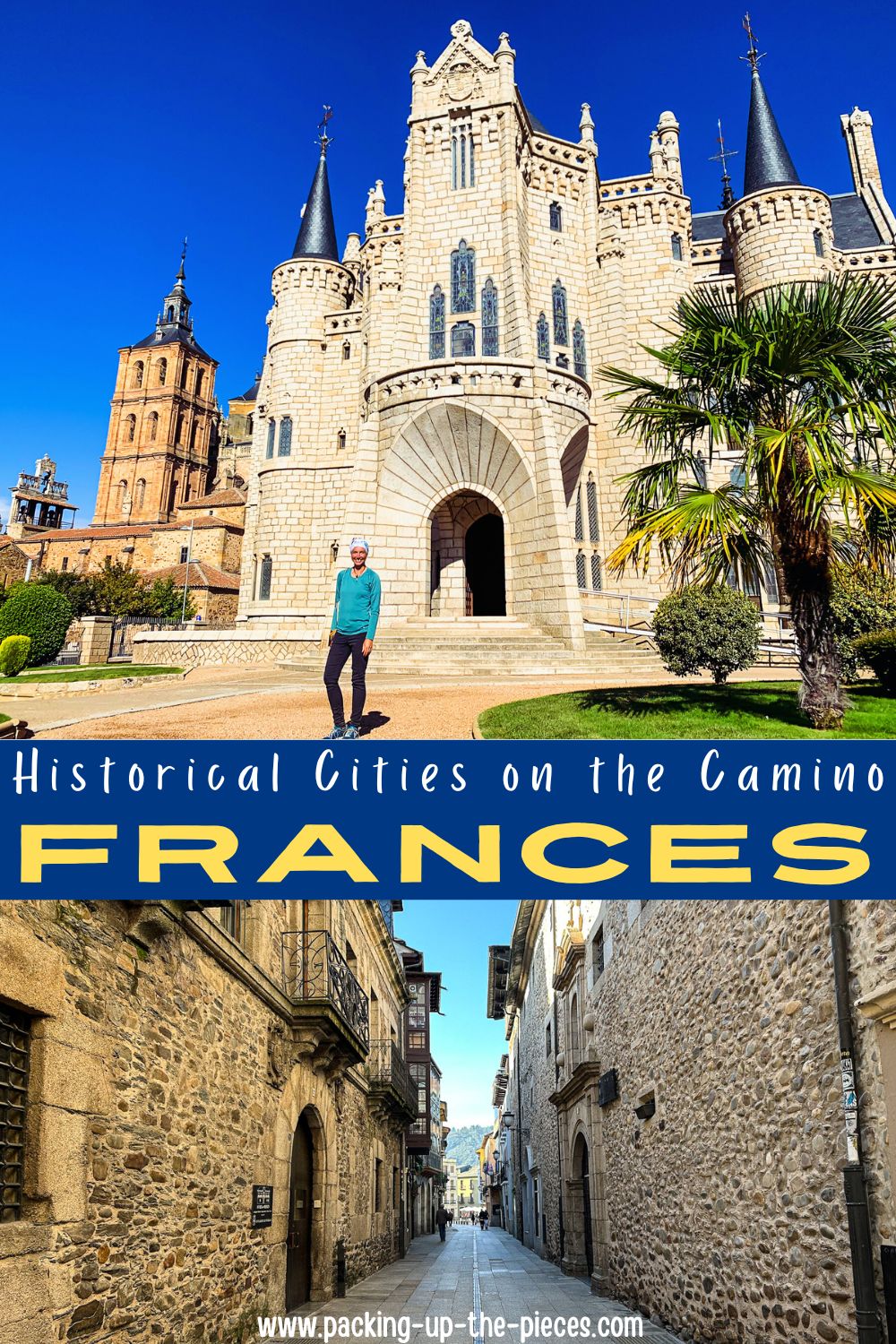
By far the most popular thing to do in Astorga is to visit the Palacio Episcopal (Bishop’s Palace), designed by Gaudí. The entire building is stunning and many of the artifacts are related to the Camino de Santiago.
Astorga was a significant stop for pilgrims during the Middle Ages. The Via de la Plata merged in the city, and there were over 20 pilgrim hospitals. Many pilgrims would rest and recover after making the long journey through the Meseta.
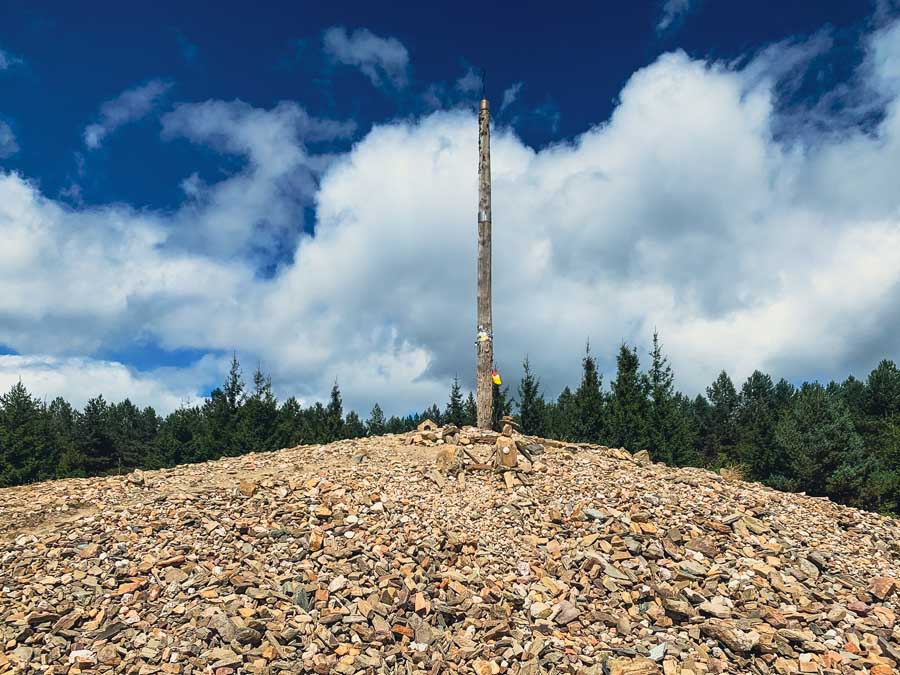

The area between Astorga and Molinaseca is said to be home to the mysterious Maragatos culture. The Maragateria region is made up of around 40 villages spread across the Montes de Leon, and they have their own cuisine, traditions, and colorful clothing. However, their origin story remains a mystery.
A highlight in Astorga is to head to the Plaza Mayor and look for the clock tower of the City Hall. On the hour, two figurines dressed in traditional Magatato clothing ring the bell. Wander through the streets of Old Town, where you can see remnants of the Romans’ rule. The area is also famous for its delicious chocolate.
Places for Pilgrims to Sleep in Astorga
- Albergue Siervas de María (Albergue de Peregrinos) / 156 Beds/ NO RESERVATIONS / 7 €
- Albergue de peregrinos Franciscano / 60 Beds / 10 €
- Albergue Só Por Hoje
- Albergue San Javier
More Places to Stay in Astorga
➜ Browse all the Best Places to Sleep in Astorga
6 | Ponferrada | Castile & León

- Population: 68,736
- Typical Walking Stage: +/- 25 Days from Saint-Jean-Pied de Port
- Distance to Santiago de Compostela: 210 Km (130.5 miles)
- Why It’s Significant on the Camino Frances: Ponferrada has been a signficant city for pilgrims since the Middle Ages and was a hub for the Knights Templar.
The city of Ponferrada has always been an important city on the Camino Frances for pilgrims. Ponferrada gets its name from the ancient bridge of Pons Ferrata, which translates from Latin to iron bridge. The bridge was said to be reinforced with iron to help with the rising number of pilgrims crossing the bridge.
The Knights Templar came into possession of the old hilltop fortress at the beginning of the 12th century. The castle was mainly used to help protect medieval pilgrims walking the Camino de Santiago. Many of the Knights would ensure the safe passage of the pilgrims across the Iron Bridge and beyond.
The historic medieval quarter of Ponferrada offers plenty of things to see. Of course, don’t miss the Templar Castle and spend some time getting lost throughout the cobblestone streets of Old Town. Wander along the Sil River (Rio Sil) and stroll the dirt paths near the castle and to the Pons Ferrata bridge.

If taking a rest day in Ponferrada, take the scenic walk to visit the quiet chapel of Santo Tomás de las Ollas. It’s a lovely viewpoint, and the old chapel has special energy. If you love the chapel of Santo Tomas de las Ollas, you could also take a day trip to visit Peñalba de Santiago.
I ended walking to Peñalbe de Santiago via the Ozo Valley and the Aquilianos Mountains. This is one of my favorite places on any Camino route.


Ponferrada is also an important place where pilgrims can choose to divert off the Camino Frances. While most pilgrims continued along the French Way of Saint James over the Pons Ferrata, other pilgrims walking during the winter months chose to avoid the high mountain passes near O’ Cebreiro.
Those pilgrims looking to reach Santiago de Compostela could deviate in Ponferrada at a lower altitude along the Winter Way. The Camino de Invierno stays at a relatively lower altitude than the Camino Frances.
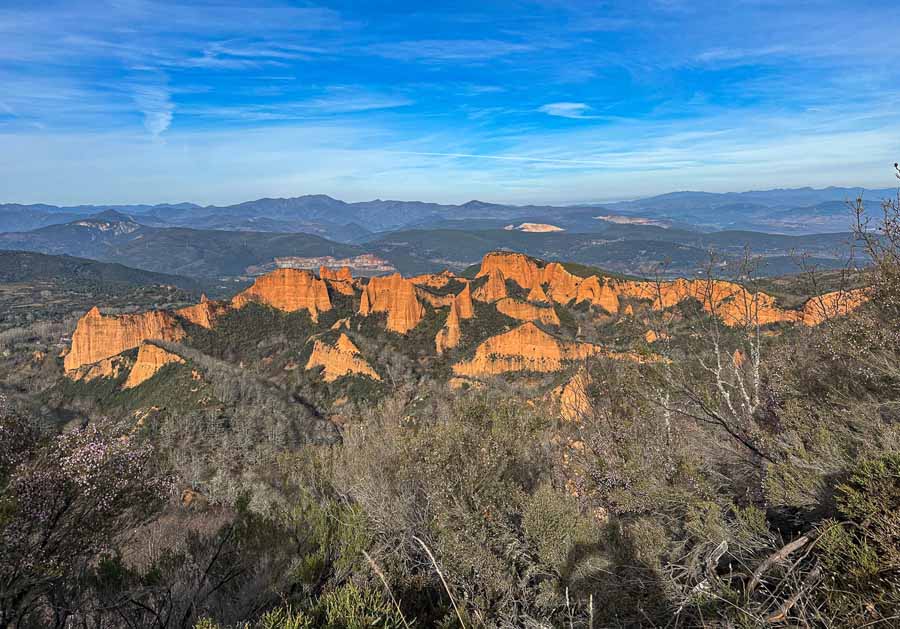
The Camino de Invierno follows the Sil River and twists through other scenic river valleys. The Camino de Invierno sees fewer pilgrims and includes highlights from Las Medulas, the incredible Ribeira Sacra, untouched villages, and the legendary spot of Pico Sacro.
Popular Places to Stay in Ponferrada for Pilgrims
- Albergue de Peregrinos San Nicolás de Flue / 186 Beds/ NO RESERVATIONS / 7 €
- Albergue Guiana
- Albergue Alda Pilgrim Ponferrada
- Albergue El Templarin
- Hostal Rio Selmo
- Hostal Nirvana
More Places to Stay in Ponferrada
➜ Browse all the Best Places to Stay in Ponferrada Spain
The End of the Camino | Santiago de Compostela


- Population: 99,491
- Typical Walking Stage: +/- 33 Days from Saint-Jean-Pied de Port
- Why It’s Significant on the Camino Frances: Santiago de Compostela is the end of the road for all pilgrims, no matter which route they chose. It is said that Saint James is buried under the Cathedral of Santiago de Compostela
For many pilgrims, Santiago de Compostela is the end of the journey. The bustling city is full of life, energy, historical sites, and delicious food.
The Old Town in Santiago is a UNESCO World Heritage Site and is home to the impressive Cathedral of Santiago de Compostela. Pilgrims will reach the Obradoiro Plaza (Praza do Obradoiro) where they can take time to reflect, visit the Cathedral, or attend the pilgrims mass.
There are numerous plazas surrounding the Cathedral like nearby Quintana Square (Praza da Quintana), which was an old cemetery. The upper staircase is known as the Praza da Quintana de Vivos (of the living) and the lower plaza Praza da Quintana de Mortos (of the dead).

The Praza das Praterías is another lovely plaza found alongside the cathedral with its famed horse fountain. This is also the plaza to enter the Cathedral for mass. During the summer months, this plaza is often filled with musicians and street performers making it one of the liveliest.
Plaza de la Inmaculada is another fantastic plaza found on the east side of the cathedral. This is one of the quieter plazas. This plaza is also home to the Monastery of San Martiño Pinario, which is the third-largest building in Spain. The Monastery of San Martiño Pinario houses a museum and the popular Hospedería San Martín Pinario.
More sights in Santiago de Compostela include the bustling Mercado de Abastos, the Pilgrim Museum, and Alameda Park, which is an awesome urban park located just steps away from the Cathedral of Santiago de Compostela.

Personally, I love spending 2 days in Santiago de Compostela. With two days, it’s worth getting more off the beaten path. Visit my favorite museum in Santiago de Compostela, Museo do Pobo Galego, and stroll through the Park of San Domingos de Bonaval. It’s also ample time to delve into the rich cuisine of the Galicia region.
There are also numerous day trips from Santiago de Compostela that make the city a must-visit destination in Spain.
Many pilgrims may feel called to continue their journey and walk to the “End of the World,” on the Camino Finisterre Muxia. There are two options when departing from Santiago de Compostela: to walk first to Finisterra or Muxia.
Popular Places to Stay in Santiago de Compostela for Pilgrims
I’ve stayed numerous times in Santiago de Compostela, and these are my best recommendations.
- Seminario Menor de la Asunción
- Albergue Santiago KM0
- The Last Stamp
- Albergue Azabache
- Albergue SP 55 by Bossh! Hotels
Popular Places to Stay in Santiago de Compostela
- Parador de Santiago – Hostal Reis Catolicos
- Hospedería San Martin Pinario
- Hotel Rua Villar
- Hotel Plaza Obradoiro
- Pensión A Casa do Peregrino
➜ Browse All the Places to Stay in Santiago de Compostela
Conclusion | The Historical Cities on the Camino Frances

In short, this is an overview of the six main historical cities on the Camino Frances. These cities include Pamplona, Logroño, Burgos, León, Astorga, and Ponferrada. As a bonus, I’ve included the official end of the Camino de Santiago, Santiago de Compostela.
This includes things to do in all the cities, a brief history, and the main attractions. Each of these historical cities on the Camino Frances make excellent option for rest days for pilgrims. All of these cities include famous cathedrals, museums, and delicious local cuisine.
Oftentimes, these Camino Frances cities become a highlight of the Camino route.
Have you visited any of these cites on the Camino Frances? Did you take a rest day here? I’d love to know your experience in the comments below!
Pack This Post for Later! Pin It!


Disclaimer: There’s a chance this post contains affiliate links, and I receive a small (but grateful) portion of the sale. There’s no extra cost to you, and I only promote things that I use and love.


